
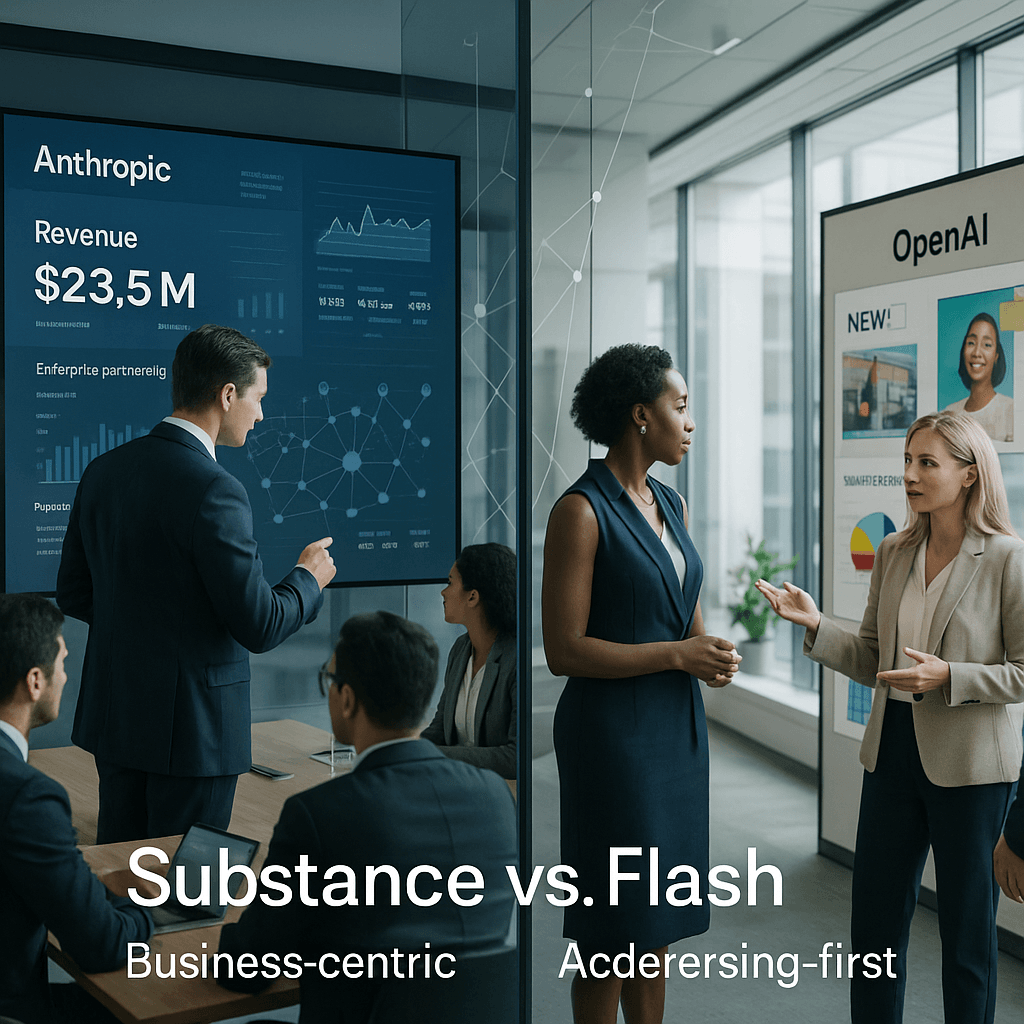
The competitive landscape in artificial intelligence (AI) and automation platforms is increasingly becoming a battleground for dominance, with companies like OpenAI and Anthropic positioning themselves distinctly in what can be viewed as a modern-day AI arms race. While both entities are major players offering transformative capabilities for small and medium business (SMB) leaders, understanding their comparative strengths, weaknesses, costs, return on investment (ROI), and scalability is critical for businesses that seek to adopt these technologies effectively.
OpenAI’s suite of tools, particularly its GPT series, has gained extensive attention due to its remarkable language processing capabilities and successful integration with various applications. The platform’s intelligent text generation, question-answering, and summarization capabilities have attracted a substantial user base, positioning OpenAI ahead in public perception and market visibility. A significant strength of OpenAI resides in its extensive model training, which allows for advanced contextual understanding, making it suitable for applications ranging from customer service automation to content creation.
However, this capability does not come without cost. Users face monthly subscription fees that may hinder some SMBs, especially in the nascent stages of their automation journeys. The pricing model can escalate quickly with increased usage, particularly for larger enterprises that need high-volume interactions. Furthermore, while OpenAI’s capabilities are vast, the focus on consumer marketing and visibility raises questions about its suitability for business-focused applications. Would the enterprise customer find sufficient support and customization for specific needs amongst the flashiness?
On the other hand, Anthropic has cultivated its brand identity in juxtaposition to OpenAI by prioritizing a revenue-driven approach that blends practical sales strategies with a less sensational marketing footprint. The company has been methodical in establishing connections with potential enterprise customers, positioning its Claude AI assistant as a safer and more transparent option for those wary of AI implementations. For SMBs concerned about AI ethics and compliance, this approach may provide a vital reassurance in adopting AI solutions. Notably, Anthropic’s partnerships, such as with Amazon, have allowed it to secure immense financial backing that could facilitate research and development necessary for ongoing improvements and feature expansions.
However, Anthropic’s focus on addressing enterprise concerns may come at the cost of broader market visibility. Companies seeking more advanced functionalities and integrations might find Anthropic lacking in some areas currently dominated by OpenAI’s established ecosystem. The learning curve associated with a newer brand may also present challenges in user adoption and resource alignment.
When comparing automation platforms like Make and Zapier, a similar analysis applies. Make, formerly known as Integromat, offers a more visually intuitive approach to automation with an emphasis on custom workflows and detailed data manipulation. This visual platform can be particularly beneficial for SMBs that prioritize a hands-on, customizable approach to automation. However, the complexity of its interface may deter users with less technical proficiency, presenting a barrier to entry.
Conversely, Zapier excels in its user-friendly design, allowing non-technical users to build automations quickly and efficiently. Its pre-built integrations with thousands of applications ensure that SMBs can leverage their existing software ecosystems without extensive reconfiguration. Yet, this strength in accessibility often comes at the expense of flexibility and complexity, as Zapier may not support highly customized workflows as effectively as Make can.
From a cost perspective, both platforms operate under varied pricing strategies that can scale according to business needs. Zapier’s tiered pricing model can become costly for users relying on high-volume automations, while Make offers a more competitive pricing structure for multi-step workflows, providing potentially better ROI for users focused on sophisticated implementation without the overhead of extensive license costs.
In assessing the return on investment of either AI platform, the key lies in aligning the selected technology with specific business outcomes. SMB leaders should consider the nuances of each platform—their capacities for helping to automate repetitive tasks, enhance productivity, and ultimately drive down operational costs—compared to the required investment to implement and maintain these solutions.
For businesses scaling their operations, scalability must also be evaluated. OpenAI and Anthropic offer robust capacities that extend over various sectors, but Anthropic’s focused approach makes it potentially more adaptable to niche markets that require specialized AI solutions. Meanwhile, the fluid scalability of Make versus Zapier will depend heavily on the complexity of the automation needs and the existing tech stack of the SMB.
In conclusion, both OpenAI and Anthropic exhibit substantial strengths and weaknesses, yielding different payoffs for SMBs that may be swayed by marketing or practical functionality. The choice between them—and akin platforms like Make and Zapier—should be dictated by an enterprise’s particular needs, technical proficiency, sensitivity to costs, and long-term goals for growth.
Adopting these technologies isn’t merely about immediate capabilities but rather the strategic foresight in aligning with solutions poised to fuel future growth.
FlowMind AI Insight: As the AI and automation landscape evolves, businesses must invest in technologies that not only meet current operational needs but are also scalable and adaptable to future market changes. A careful evaluation of each platform’s alignment with organizational goals will elucidate the best path forward in integrating AI and automation into business processes.
Original article: Read here
2026-02-11 10:09:00