
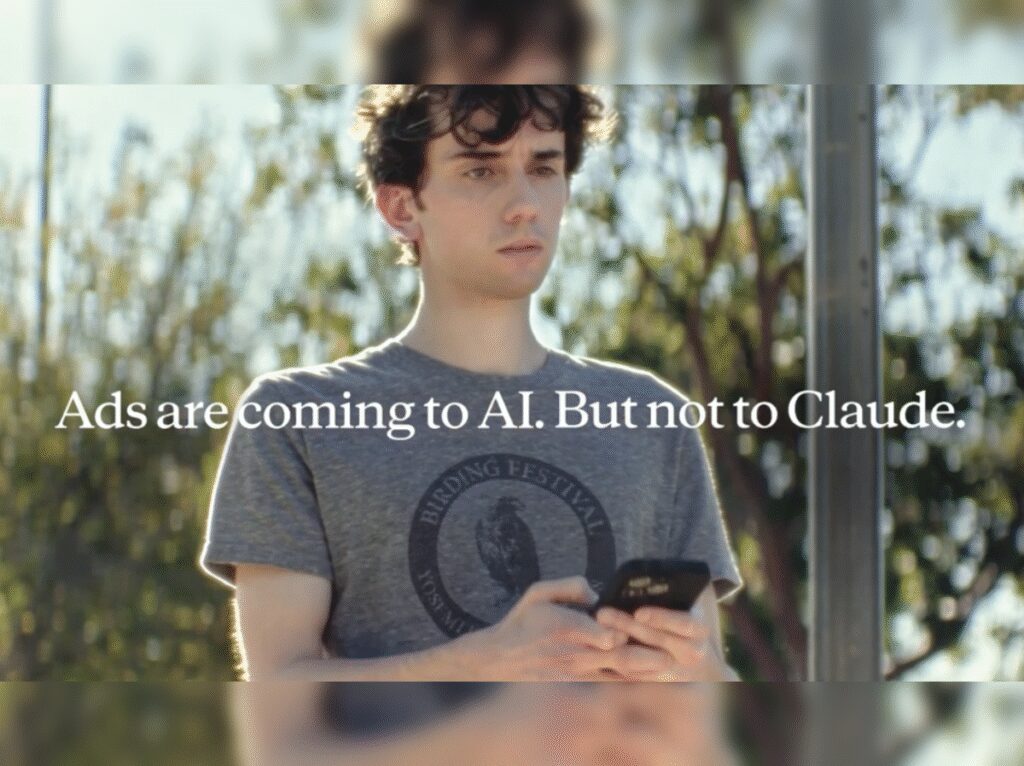
The ongoing rivalry between Anthropic and OpenAI has reached a new level of visibility following Anthropic’s strategic marketing initiative during the Super Bowl. By launching a campaign that humorously critiqued OpenAI’s recent pivot towards advertising within its ChatGPT platform, Anthropic successfully raised awareness of its own Claude chatbot, which saw a notable surge in downloads, ranking tenth on the US App Store shortly after the ads aired. This 32% increase in downloads—up from approximately 112,000 to 148,000 in just a few days—illustrates the power of distinct positioning and targeted marketing in a competitive landscape.
At a glance, the tactical approach adopted by Anthropic appears to address key market concerns regarding user trust and perceived value in AI applications. Unlike OpenAI, which has opted to incorporate ads for its free and lower-end ChatGPT offerings, Anthropic’s messaging promises a “no ads” experience, appealing to consumers increasingly skeptical of manipulative advertising practices. This divide aligns with broader trends in user preference for platforms that prioritize transparency and user experience over revenue generation.
Anthropic’s advertisements cleverly depict chatbot experiences that many users might find familiar: overly enthusiastic responses and an insistent push to sell products. While both companies leverage advanced AI technologies, the narratives they craft fundamentally distinguish their market approaches. OpenAI’s strategy to monetize through ads could potentially undermine user trust, whereas Anthropic’s openness about its ad-free model positions Claude as a more user-centric alternative. Sam Altman, CEO of OpenAI, responded to Anthropic’s campaign by labeling it as “clearly dishonest,” contrasting the nature of the products offered by both organizations. He asserted that ChatGPT serves far more users, emphasizing reach and accessibility, which are crucial metrics in evaluating platform effectiveness.
From a business perspective, the implications of these contrasting strategies can impact scalability and return on investment (ROI). OpenAI’s monetization strategy via advertising may initially enable substantial revenue gains, but could lead to a consumer backlash if users perceive the ads as intrusive or detracting from the core functionality of the service. With a large user base, the volume of ads may also risk diluting the user experience, leading to decreased satisfaction and higher churn rates over time.
In contrast, Anthropic’s focus on enterprise solutions for Claude could drive sustainable growth and customer loyalty among businesses seeking reliable, ad-free AI solutions. For SMB leaders and automation specialists, the choice between these platforms boils down to usability, trust, and strategic alignment with business objectives. While Claude’s initial market entrance was less robust than its competitor, this recent surge suggests that targeted marketing and a clear value proposition can significantly alter a platform’s market position, even in a crowded space.
However, the cost of adopting either solution also plays a critical role in decision-making. OpenAI’s API pricing model offers various tiers, accommodating both low-budget and enterprise-level customers. In contrast, Anthropic has prioritized selling its product to businesses, which may afford it a higher price point with potential for premium services tailored to corporate users. Here, SMB leaders must carefully consider their operational budgets against expected usage and growth trajectories, as adopting a higher-cost platform could either enhance operational efficiencies or strain financial resources without a clear path to ROI.
In assessing the tools available, it is vital to analyze strengths and weaknesses beyond mere feature sets. OpenAI benefits from its established brand recognition and broad accessibility, while Anthropic garners trust with its commitment to user experience. For automation specialists comparing tools like Make and Zapier, similar analysis criteria should apply. Both platforms offer extensive integrations but differ in pricing structures and functionality depth, impacting their suitability for various business scenarios.
As competition intensifies in the AI landscape, understanding these nuances becomes essential for SMB leaders. Choosing the right AI and automation tools is no longer just about functionality; it encompasses a strategic mindset that evaluates user experiences, market forces, and long-term growth prospects.
Ultimately, as businesses navigate this landscape, they must align their chosen platforms with their core values, operational needs, and user expectations. Anthropic’s recent campaign serves as a case study in effective positioning that resonates with audience sentiments amidst growing skepticism toward traditional monetization strategies in AI.
FlowMind AI Insight: The recent surge in Claude’s downloads highlights the importance of distinct market positioning and user trust in driving engagement. For SMBs, prioritizing user experience in tool selection will not only foster loyalty but can also enhance long-term sustainability in a competitive landscape where consumer preferences are rapidly evolving.
Original article: Read here
2026-02-14 08:59:00