
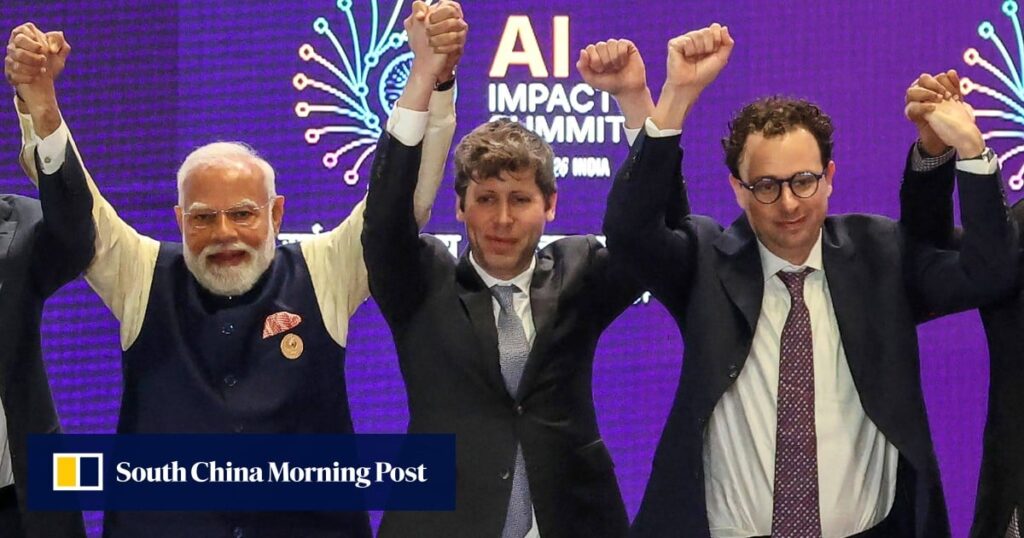
In the rapidly evolving landscape of artificial intelligence, the relationship between competitors can often be a litmus test for industry dynamics. The recent interactions between Sam Altman of OpenAI and Dario Amodei of Anthropic at India’s AI Summit exemplify this tension. Both leading figures represent the apex of AI innovation, yet their companies underpin contrasting philosophies that could inform strategic decisions for small and medium-sized business (SMB) leaders and automation specialists.
OpenAI has emerged as a frontrunner in the AI sector, distinguished by its strong focus on product development and widespread commercial applications. With an estimated valuation of approximately $500 billion, its flagship products, such as ChatGPT, prioritize user accessibility and extensive training datasets. This makes OpenAI particularly advantageous for businesses seeking scalable solutions capable of automating customer service, enhancing content creation, and driving data analysis.
Alternatively, Anthropic, valued around $380 billion, operates under a different set of guiding principles, influenced in part by Amodei’s departure from OpenAI due to perceived commercial overreach. Anthropic emphasizes ethical AI development and safety measures in its offerings. This ethical grounding is increasingly appealing for companies wary of the implications of AI misuse. SMBs focusing on social responsibility or those operating in regulated industries may find this alignment particularly beneficial.
A critical consideration in choosing between these two platforms is cost. OpenAI offers a range of pricing tiers, appealing to businesses of various sizes while providing user-friendly scalable solutions. However, its subscription-model pricing might be seen as potentially increased overhead for SMBs with tighter budgets. Anthropic, still in its growth phase, may offer more customized pricing for businesses explicitly aiming for safety-first innovations, yet the lack of widespread products may limit immediate accessibility.
In terms of return on investment (ROI), both companies present compelling case studies, although the pathways diverge significantly. OpenAI’s rapid deployment model allows for swift implementation, which can lead to quicker productivity gains. For businesses that require fast results from automation—such as marketing agencies or customer support teams—OpenAI can yield substantial returns in a short time frame. Conversely, Anthropic’s longer development cycles may lead to immediate costs without immediate returns. However, companies willing to invest in the long-term reliability of AI systems may ultimately find that the proactive measures taken to mitigate risk will translate into better ROI down the line.
As the AI market matures, scalability becomes paramount. OpenAI excels in this area due to its infrastructure that accommodates massive user bases without compromising performance. Its API interfaces allow companies to bridge multiple applications seamlessly—a crucial factor for SMB leaders looking to future-proof their operations. On the other hand, Anthropic’s systems are designed to scale while prioritizing safety and reliability, which is inherently beneficial for those prioritizing ethical AI deployment. That said, current market penetration suggests that OpenAI has a wider reach and more established partnerships, potentially giving it an edge in immediate scalability.
What does this unfolding rivalry signify for SMB leaders? Firstly, the nuance between immediate versus long-term gains can fundamentally affect investment strategies. If speed and user engagement are vital, OpenAI may represent the preferable option. However, for businesses with a more methodical approach that values ethical implications, Anthropic could deliver sustained competitive advantages through rigorous AI governance.
Furthermore, leveraging AI tools necessitates an evaluation of organizational readiness. Companies must assess not just financial considerations but also operational capabilities. A tool that drives efficiency should align with existing workflows and the skill set of the workforce. Hence, leaders should prioritize platforms that offer robust training and integration support.
The visible tension between Altman and Amodei serves as a reminder that competition fosters innovation, but it can also lead to fragmentation. Each company’s value proposition presents opportunities and challenges for SMBs. It fosters the need for leaders to not only weigh options based on the technical efficiency of the tools but also on the ethical standards and societal implications the AI solutions may impart.
In conclusion, the decision between OpenAI and Anthropic, like many technology choices in business today, ultimately comes down to the alignment of strategic goals with practical needs. Engaging in a thorough assessment of each tool’s capabilities, costs, ethical ramifications, and long-term scalability will enable decision-makers to choose the solution that best fits their organizational objectives.
FlowMind AI Insight: As the AI landscape continues to evolve, SMBs must remain vigilant and informed about the shifting dynamics and ethical considerations in AI development. Balancing immediate operational needs with long-term strategic goals will be crucial for sustainable growth and innovation.
Original article: Read here
2026-02-20 04:16:00