
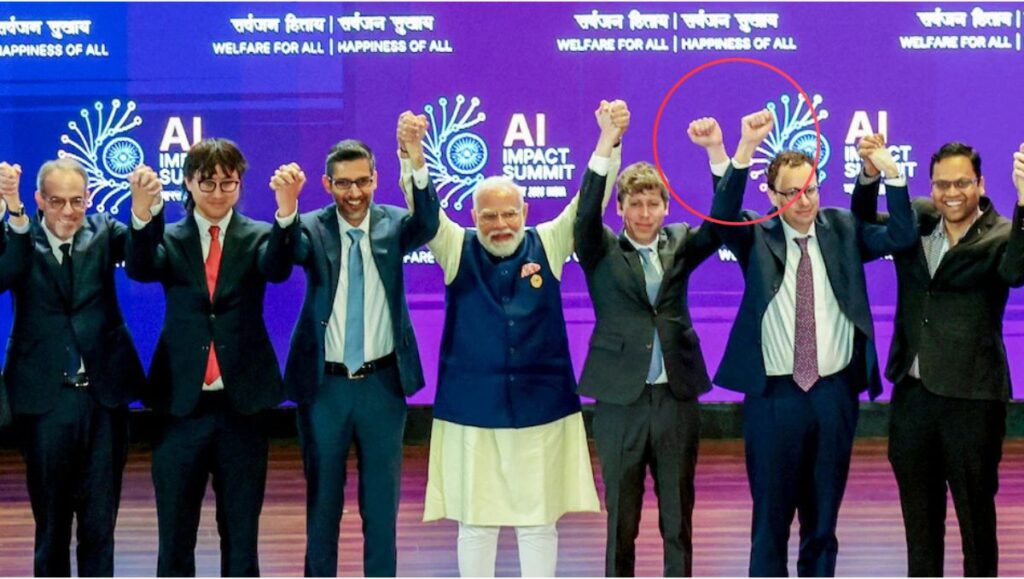
At the India AI Impact Summit, an incident involving prominent tech leaders Sam Altman of OpenAI and Dario Amodei of Anthropic illustrated not only the personalities behind such influential organizations but also the current atmosphere of competition and collaboration within the field of artificial intelligence. While this moment may have been perceived as awkward or humorous, it casts a light on the competitive dynamics and contrasts between two of the leading AI platforms in the industry today.
OpenAI and Anthropic have established themselves as key players in the AI landscape, but their development trajectories and corporate philosophies diverge significantly. The historical context is crucial; Altman and Amodei once shared a professional rapport at OpenAI before Amodei departed to create Anthropic, primarily due to internal disagreements regarding the strategic direction of AI development. This rift not only marked a personal division but also gave rise to two competing visions for the future of artificial intelligence, each backed by a different approach to ethics, safety, and product offerings.
Examining the strengths and weaknesses of these platforms is critical for small to medium-sized business (SMB) leaders seeking to leverage AI-driven automation. OpenAI has struck a chord with its user-friendly API offerings, extensive documentation, and a broad range of applications—from natural language processing to image generation. This accessibility has made it a go-to choice for organizations looking to integrate AI with minimal upfront investment. Analysts have noted that OpenAI’s comprehensive ecosystem allows for rapid prototyping and deployment, presenting a strong return on investment (ROI) for organizations that make use of automation for repetitive tasks or data analysis.
Conversely, Anthropic takes a more cautious approach, prioritizing AI safety and long-term alignment issues, which resonate well with businesses that place a premium on ethical considerations and risk management. This focus inherently creates a certain level of trust among its users, particularly in sectors where compliance and ethical standards are paramount. However, the trade-off is evident; the performance of Anthropic’s tools may lag in certain areas compared to OpenAI’s diverse offerings, and the initial costs associated with implementing its platform could be higher due to a steeper learning curve and extensive vetting processes that cater to safety concerns.
In terms of scalability, both platforms present unique opportunities. OpenAI’s tools are designed with scalability in mind; their robust API allows seamless integration within existing frameworks, making it suitable for businesses planning to expand or evolve their AI use rapidly. Nonetheless, Anthropic has begun to roll out features that emphasize modular integrations, which could appeal to businesses wary of full-scale migrations but still looking for advanced AI capabilities. This segmented approach could provide significant ROI for SMBs by allowing them to adopt AI incrementally.
Understanding the cost implications is essential for decision-makers. Initial licensing costs for both platforms can vary based on usage levels and features. OpenAI tends to offer more competitive pricing structures for startups and smaller businesses, which is beneficial for companies that may have limited budgets but significant creative aspirations. On the other hand, while Anthropic’s pricing is typically higher, it includes dedicated customer support—an asset for firms requiring a customized approach to their AI strategies. This added value could lead to better long-term ROI, especially for businesses operating in specialized or highly regulated markets.
As AI technology continues to advance rapidly, the market landscape is also changing, influenced by external factors such as regulatory scrutiny, public perception of AI, and economic conditions. The competitive environment between OpenAI and Anthropic suggests a driving force for innovation and ethical compliance. Consequently, SMB leaders should be aware of how each platform’s philosophical stance can affect its product offerings and what that might mean for their own business operations.
In conclusion, the AI industry is in a state of heightened competition, particularly between OpenAI and Anthropic. For SMBs, this means a wealth of choices—each with its own benefits and potential drawbacks. The key takeaway for leaders is the importance of not only assessing immediate performance metrics but also considering long-term implications regarding ethical alignment and scaling capabilities of chosen AI solutions.
FlowMind AI Insight: In navigating the competitive landscape of AI platforms, SMB leaders must carefully weigh immediate needs against long-term ethical considerations and scalability. The choice between OpenAI and Anthropic is not merely tactical; it is emblematic of broader values that can define a company’s trajectory in the rapidly evolving digital economy.
Original article: Read here
2026-02-20 06:53:00