
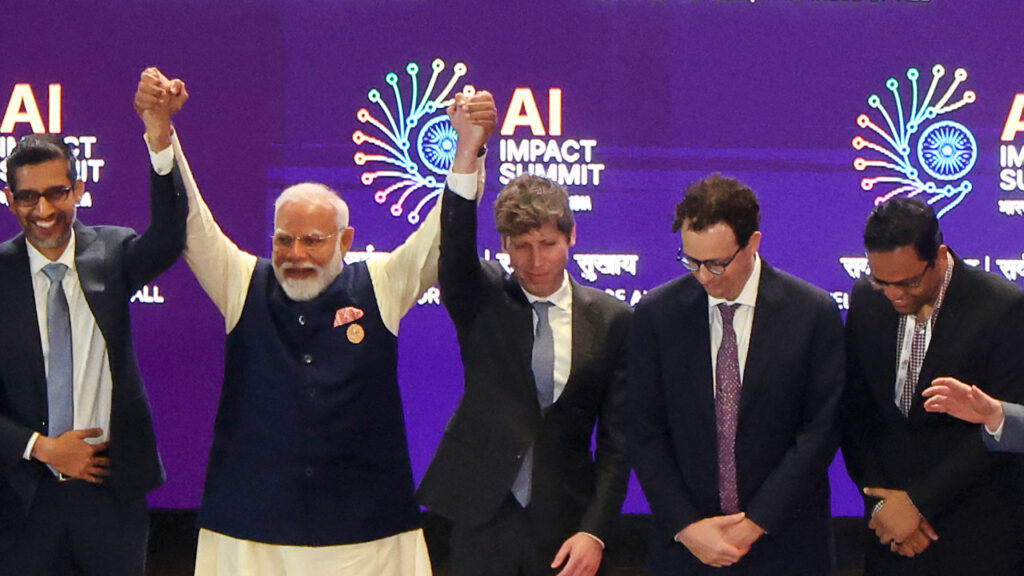
As the landscape of artificial intelligence and automation continues to evolve, the competitive dynamics between major players have significant implications for small to medium-sized business (SMB) leaders and automation specialists. At a recent AI summit in India, tensions between Sam Altman of OpenAI and Dario Amodei of Anthropic were palpable, illustrating the rivalry that shapes the tools and platforms available in the market today. This rivalry is underscored by differences in approach, pricing, scalability, and overall business value, which SMBs must navigate to leverage AI effectively.
When evaluating automation platforms, two notable competitors are Make and Zapier. Make, frequently viewed as an advanced automation tool, offers greater flexibility for complex workflows. Its visual interface allows users to design intricate automations with minimal coding skills, thus catering to businesses looking for a high level of customization. In contrast, Zapier positions itself as user-friendly and accessible to non-technical users, focusing on straightforward integrations that require less upfront training. While Zapier supports a wide array of apps, its capacity for handling complex scenarios may be limited compared to Make.
In terms of cost, Zapier takes the lead with a free tier that is appealing to startups and SMBs looking to test the waters. However, as business needs evolve and require higher thresholds for tasks or data points, costs can escalate rapidly with Zapier’s tiered pricing model. Make, on the other hand, offers a more predictable pricing structure based on the number of operations, which may result in better ROI as businesses scale their automation efforts. This aligns well with the often unpredictable nature of small business growth. For companies planning to expand automation in the long term, Make could prove to be a cost-effective investment despite higher upfront costs.
From a scalability viewpoint, both platforms offer capabilities, but they cater to different needs. Make excels when handling intricate processes, making it suitable for businesses that anticipate rapid processes requiring constant adjustment and refinements. Zapier, while robust, tends to function best within a more static framework of tasks, where integrations can be simplified. For SMBs focusing on an iterative approach to automation that can evolve alongside changing market dynamics, Make may provide the agile flexibility needed for sustained growth.
Turning to the realm of AI, the juxtaposition between OpenAI and Anthropic provides another layer of analysis for SMB leaders. OpenAI’s GPT models, widely recognized for their conversational capabilities and diverse applications, position the company as a key player for businesses seeking to enhance customer interactions or automate content creation. However, its potential for ethical concerns and bias remains a notable drawback, as seen in various reports highlighting these issues.
Anthropic, while newer to the field, focuses heavily on ethical AI usage and safety, raising questions about whether such considerations can materially impact their market relevance. Their approach indicates a considerable commitment to responsible AI development, which could attract businesses prioritizing ethical standards in their operational frameworks. Yet, Anthropic’s relatively limited exposure compared to OpenAI may hinder its ability to serve a broad range of applications immediately, which is often a critical factor for SMBs looking for quick, implementable solutions.
Cost-wise, both OpenAI and Anthropic present different pricing structures that can influence SMB decisions. OpenAI’s pay-as-you-go model allows businesses to scale resources according to usage, which is a perfect fit for companies with fluctuating or unpredictable AI demands. In contrast, Anthropic’s focus on a subscription model could provide more consistency in budgeting, albeit typically without the flexibility of paying for actual use—not a minor consideration for cash-strapped SMBs.
The effectiveness of these tools ultimately hinges on their ROI potential. For instance, companies leveraging OpenAI’s models often report enhanced customer engagement and improved operational efficiencies, justifying the investment, especially in sales or customer service functions. However, the actual benefits are contingent on the careful implementation and ongoing evaluation of AI outputs to mitigate biases and ethical concerns. On the other hand, businesses gravitating toward Anthropic might achieve greater satisfaction in terms of ethical compliance and safety, albeit potentially at the cost of broader functionality in the short term.
In conclusion, when navigating the complexities of AI and automation tools, SMB leaders and automation specialists must weigh options carefully. While Make and OpenAI both provide viable paths toward achieving heightened productivity, each has strengths and weaknesses that must align with a business’s specific needs and long-term goals. The choice between platforms like Zapier and Make, or OpenAI and Anthropic hinges on operational flexibility, cost structures, ethical considerations, and scalability potential. Aligning these factors with an organization’s strategic vision is paramount for optimizing outcomes and achieving sustainable growth.
FlowMind AI Insight: As competition intensifies among leading AI and automation platforms, SMB leaders must stay attuned to evolving functionalities and pricing models. Balancing flexibility, cost, and ethical considerations will be essential for leveraging these tools effectively in a rapidly changing landscape.
Original article: Read here
2026-02-19 08:23:00