
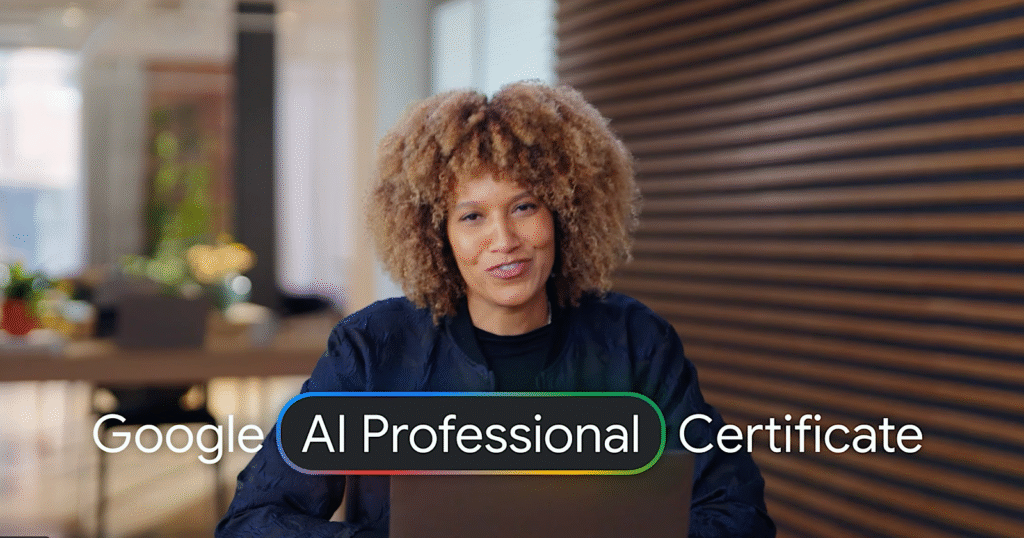
The launch of the Google AI Professional Certificate signals a significant shift in the landscape of artificial intelligence (AI) and automation training for small and medium-sized businesses (SMBs). As the digital transformation progresses, the need for skilled professionals in AI-related fields grows more pressing. This program offers an opportunity for SMB leaders and automation specialists to enhance their competencies while navigating the diverse toolsets available in the marketplace.
The certificate program is available through Coursera, Google Skills, and Udemy, allowing participants the flexibility of self-paced learning. At a cost of $49 per month or completely free for eligible U.S. small businesses, it aims to demystify AI tools ranging from data analysis to content creation and “vibe coding.” However, the core value proposition lies in its comprehensive structure, consisting of seven modules that each take approximately an hour to complete. This modular approach, paired with the hands-on activities, allows participants to internalize complex concepts while gaining practical application skills.
A critical aspect for SMB leaders to consider when reviewing this program is its competitive landscape. Various platforms offer similar training but with unique strengths and weaknesses. For instance, OpenAI and Anthropic represent two titans in the AI space, although they cater to different user intentions and capabilities. OpenAI focuses on powerful conversational and creative AI tools like ChatGPT, whereas Anthropic prioritizes alignment and safety in AI models. The training associated with OpenAI, although robust, can be more challenging for those less technically inclined. In contrast, Anthropic’s offerings are geared toward ethical AI usage, making it a vital choice for businesses concerned about responsible implementation.
Another comparison can be drawn between automation platforms such as Make and Zapier. While both tools facilitate seamless workflows, their functionalities differ in scalability and depth of integration. Zapier empowers users with pre-built templates for numerous applications, making it immediatel accessible. However, its extensive use may also lead to performance lags as workflows increase in complexity. Make, conversely, offers a more robust framework for specialized integrations but can be time-consuming to learn for new users. SMB leaders should thus assess their operational scale and complexity when choosing between these tools, factoring in ROI based on performance efficiency and time saved.
The ROI of investing in the Google AI Professional Certificate should not solely be measured in immediate financial terms. Training employees in cutting-edge tools enhances overall workforce effectiveness and improves decision-making capabilities. With the right competencies, businesses can leverage AI not just to automate tasks but to innovate processes, ultimately creating a competitive edge. According to research from McKinsey, organizations that adopt AI within their business models can increase productivity by up to 40%. Therefore, embedding AI literacy through certification can serve as a foundational investment in the future.
Moreover, the focus on applied use cases in the Google AI Professional Certificate offers a vital differentiator. Many existing programs emphasize theoretical AI knowledge, which may not translate effectively into day-to-day business applications. The more practical skill sets covered in the Google program, such as leveraging tools like Gemini or Google AI Studio for operational tasks, equip employees with actionable insights that can be immediately beneficial. Enabling employees to utilize AI tools for specific tasks, such as data visualization or app development without the barrier of extensive coding knowledge, can cascade benefits throughout the organization.
However, potential participants should also carefully consider the implications of program accessibility. While the free access initiative for eligible U.S. small businesses is commendable, the verification process entails specific requirements, such as providing an Employer Identification Number (EIN). This requirement may inadvertently exclude enterprises that might benefit from the training but lack the requisite documentation. As access to such educational resources continues to evolve, ensuring that all interested parties can seamlessly enroll and benefit will be key to maximizing the program’s impact.
In terms of broader business strategy, incorporating the Google AI Professional Certificate into employee development initiatives can foster a culture of continuous learning. A workforce skilled in AI and automation technologies is more dependent on agility and adaptability. As market demands shift, organizations able to pivot quickly and utilize advanced technologies stand to outperform their competitors.
In conclusion, the Google AI Professional Certificate presents an attractive option for SMB leaders looking to enhance their team’s AI competencies. While it offers robust training in practical applications, a strategic comparison to other tools and platforms remains essential for making informed investments in training and technology. The decision to incorporate these technologies should consider both immediate operational needs and long-term growth objectives.
FlowMind AI Insight: As businesses increasingly adopt AI-driven solutions, the focus should shift toward identifying tools and training that not only meet current demands but also encourage a culture of innovation and adaptability. By investing in comprehensive training programs such as the Google AI Professional Certificate, SMBs can empower teams to harness the full potential of AI, driving sustainable growth and enhanced competitiveness in an ever-evolving marketplace.
Original article: Read here
2026-02-19 19:33:00