
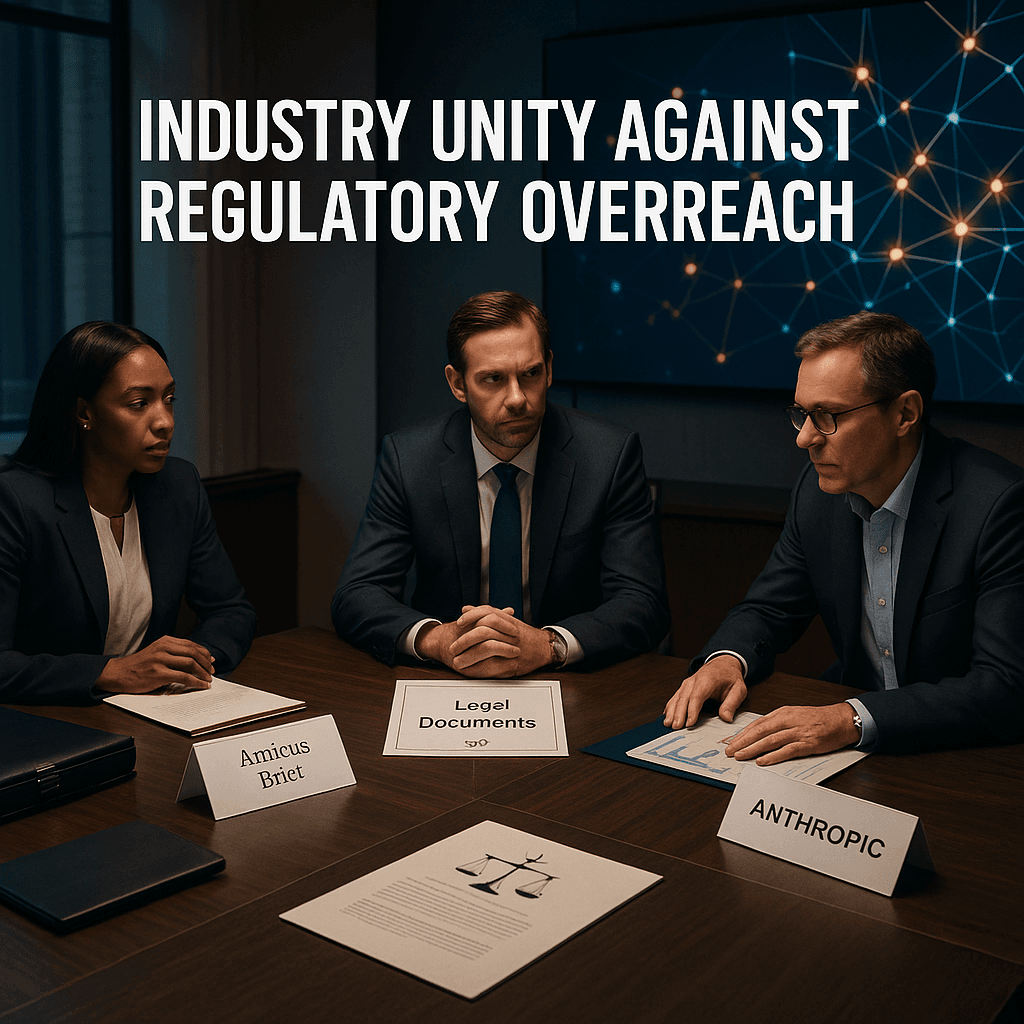
The recent legal maneuverings involving AI industry giants illustrate a critical juncture in the conflict between innovation and regulation. Employees from OpenAI and Google DeepMind have stepped forward to support competitor Anthropic in a legal battle against the Department of Defense (DoD). This unprecedented collaboration among major players underscores mounting concerns regarding government intervention in AI development and highlights the need for clarity in regulatory frameworks.
The amicus brief filed by these employees reflects a coalition of highly skilled professionals, including Jeff Dean, chief scientist at Google DeepMind. His presence exemplifies the gravity with which the AI sector views this case. While these companies are traditionally seen as competitors, their decision to unite against what many perceive as government overreach signals that the stakes extend far beyond mere market rivalry. Considered in isolation, Anthropic’s lawsuit against the DoD is not just about one company’s operational freedom; it has morphed into a larger industry concern about safeguarding the future of artificial intelligence itself.
At the core of this legal battle lies the issue of how far the government can exert influence over commercial AI labs. Anthropic’s complaint revolves around the implications of the DoD’s requests to modify safety protocols and deployment strategies related to AI models, which they argue could compromise not only individual company autonomy but also the ethical framework surrounding AI safety. If the government is allowed to exert further control over these operations, the potential for stifling innovation grows exponentially, affecting the pace at which new technologies can come to market.
This incident serves as a portent for AI regulation and its future relationship with corporate entities. As companies grapple with escalating national security requirements, the confrontation between public interest and market innovation becomes increasingly contentious. The DOD advocates for an active role in shaping AI’s safety measures, citing urgent security demands. However, companies argue that this intervention risks hampering the creativity and agility central to technological advancement.
This dichotomy can be examined through the lens of existing automation platforms like Make and Zapier, as well as advanced AI systems from contenders like OpenAI and Anthropic. Both Make and Zapier simplify automation, yet they differ in approach and scalability. Make emphasizes visual workflows that allow for intricate integrations between apps, fostering a user-friendly experience for non-technical users. Conversely, Zapier positions itself as the more establishment-oriented platform, offering straightforward task automation with a wide range of app connectivity but arguably less flexibility for complex workflows.
For SMB leaders, the choice between these platforms often hinges on immediate business needs. Companies seeking to implement quick, easy automation for basic tasks may find Zapier’s ready-made templates appealing. However, those with intricate operational frameworks requiring custom integrations may prefer Make’s extensive capabilities. The cost of both platforms is not insignificant; while Zapier offers pricing tiers suitable for various budgets, it can escalate quickly with the addition of team members or services. Make, on the other hand, presents a more value-driven proposition when scalability is considered.
From a return on investment perspective, organizations should assess the potential impact these automation tools can generate against their associated costs. Metrics like improved operational efficiency, reduced labor hours, and faster completion rates of repetitive tasks provide a clearer picture of each platform’s viability. In this context, the decision should not only involve immediate financial outlays but also long-term strategic alignment with business objectives, including how agile the chosen system will be as market conditions change.
The recommendations extend beyond selecting a platform. SMB leaders must embrace a proactive approach to understanding the implications of evolving regulations in the AI landscape. This means staying informed not only about technological options but also about potential changes in policies affecting data usage, safety measures, and operational governance. As AI regulation matures, companies will need to integrate compliance mechanisms into their business models to avoid pitfalls that could arise from government intervention.
Ultimately, as evidenced by the coalition formed around Anthropic, industry stakeholders recognize a need for aligned strategies in addressing regulatory challenges while continuing to innovate. Fostering collaboration among competitors could lead to the establishment of industry standards that promote safety and ethical considerations without hampering technological advancement.
FlowMind AI Insight: The unfolding narrative of collaboration among AI giants is a pivotal moment that may redefine industry boundaries. As SMB leaders and automation specialists, recognizing the necessity of both compliance and innovation will be crucial in navigating the rapidly shifting landscape, enabling more informed decisions that leverage technical advancements while adhering to emerging regulations.
Original article: Read here
2026-03-09 21:19:00