
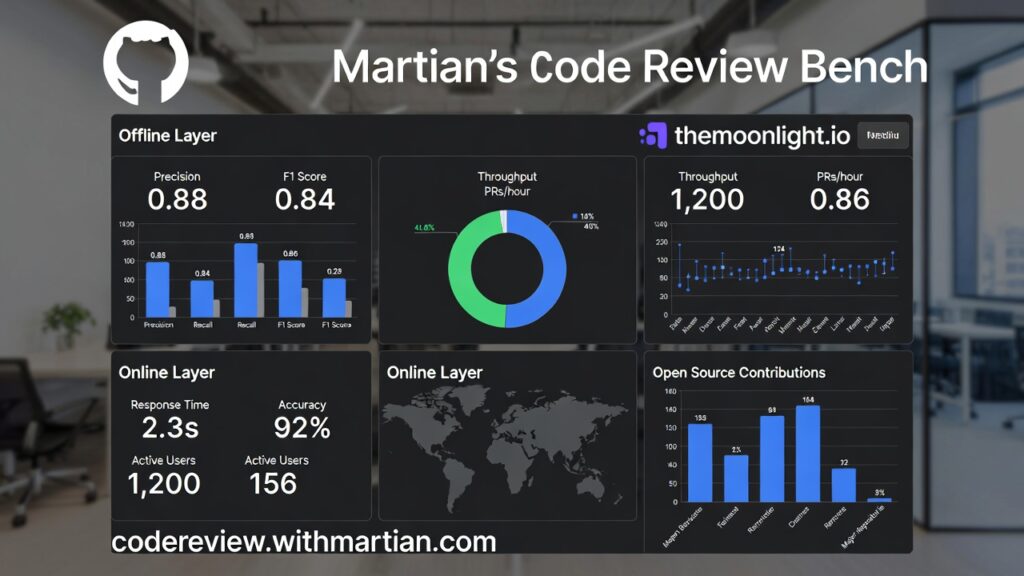
In the evolving landscape of software development, AI-driven tools have become pivotal for enhancing code quality and efficiency. With various options available, small and medium-sized businesses (SMBs) face the challenge of selecting the right automation tools that meet their unique needs. In this exploration, we’ll compare two prominent AI-based code review tools: Martian’s Code Review Bench and GitHub Copilot.
Martian’s Code Review Bench stands out due to its commitment to providing an unbiased evaluation of AI agents. Its dual-layer evaluation system comprises an offline layer that analyzes historical pull requests and an online layer that captures real-world performance in developer workflows. This benchmark addresses traditional AI evaluation flaws, such as memorization, by utilizing a robust dataset of over 1.2 million code changes from GitHub. This depth of data allows Code Review Bench to truly reflect the effectiveness of AI tools in a live coding environment, mitigating the risk of inflated scores derived from synthetic benchmarks.
GitHub Copilot, in contrast, leverages AI to enhance individual developer productivity directly by offering coding suggestions in real-time. It utilizes OpenAI’s Codex model, which has been trained on vast amounts of code from public repositories. While Copilot excels in providing timely suggestions and integrating seamlessly into the VS Code environment, it lacks the rigorous benchmarking metrics of Code Review Bench. Copilot is particularly beneficial for developers looking for immediate assistance but may not adequately assess the broader implications of AI effectiveness on team-based workflows.
Regarding pricing, Martian’s Code Review Bench is fully open-source, making it an attractive option for SMBs looking to minimize costs while investing in effective code quality assurance measures. The ability to customize and adapt the tool without incurring licensing fees can significantly reduce the total cost of ownership. In contrast, GitHub Copilot operates under a subscription-based model, which, while convenient, could add up over time, especially for larger teams.
Integrations present another crucial aspect. Code Review Bench offers compatibility with various CI/CD pipelines, allowing teams to seamlessly incorporate it into their existing development processes. This flexibility in integrations enables organizations to adapt quickly, enhancing their workflows without a significant overhaul. On the other hand, GitHub Copilot primarily integrates with GitHub and Visual Studio, which limits its usability for teams operating outside of these environments. Therefore, teams not wholly invested in these platforms might find Copilot less appealing.
Reliability is another key parameter. Martian’s tool, through its dual-layer evaluation system, ensures consistent performance metrics that do not degrade over time. This reliability is critical for organizations looking to justify their investments in AI tools. GitHub Copilot, while generally reliable for coding assistance, may vary in quality based on the context of the code being worked on, leading to discrepancies in its usefulness.
Support levels also differ between the two tools. As an open-source project, Martian’s Code Review Bench relies on community contributions and documentation for support. This model can foster innovation but may also result in slower responses for technical issues, particularly for SMBs that require immediate assistance. GitHub Copilot, being a product of GitHub, comes with the backing of commercial support, providing users with more structured help when they require it. Thus, organizations that prioritize responsive customer service might lean toward GitHub Copilot.
When it comes to the choice of tool, the decision often boils down to specific use cases. For teams needing immediate code assistance and enhanced productivity, GitHub Copilot may be the superior choice. Its real-time integration into developer environments streamlines coding processes, allowing developers to focus on more complex tasks. However, for those looking to evaluate and assure the quality of AI-assisted code reviews, particularly in collaborative settings, Martian’s Code Review Bench stands out as a more comprehensive solution.
Migration steps for either option involve several key considerations. For teams shifting to Code Review Bench, the initial phase should include evaluating existing workflows to identify integration points. This could involve setting up CI/CD pipelines to incorporate the tool into pull request processes. A low-risk pilot could involve selecting a small project to assess the effectiveness of the benchmarking tool while gathering feedback from team members.
In contrast, migrating to GitHub Copilot can be more straightforward. Teams can start by enabling the tool for all developers and providing training sessions on how to effectively utilize its capabilities. Conducting a pilot with a subset of developers also allows the team to measure productivity improvements and address any integration issues before a full rollout.
Total cost of ownership and expected ROI should be pivotal elements of the decision-making process. For Code Review Bench, the main costs may involve time spent configuring the tool and training team members. However, given its open-source nature, the long-term financial benefits could be substantial, especially if it leads to fewer bugs and faster releases. Conversely, with GitHub Copilot, the direct costs can accumulate over time, making it essential for teams to quantify productivity gains against subscription fees to assess actual ROI.
FlowMind AI Insight: As businesses continue to navigate the complexities of software development, choosing the right AI tools like Martian’s Code Review Bench or GitHub Copilot can significantly influence operational efficiency. By understanding and analyzing the unique strengths and features of each option, organizations can make data-driven decisions that not only enhance productivity but also optimize long-term investments in technology.
Original article: Read here
2026-03-10 06:17:00