
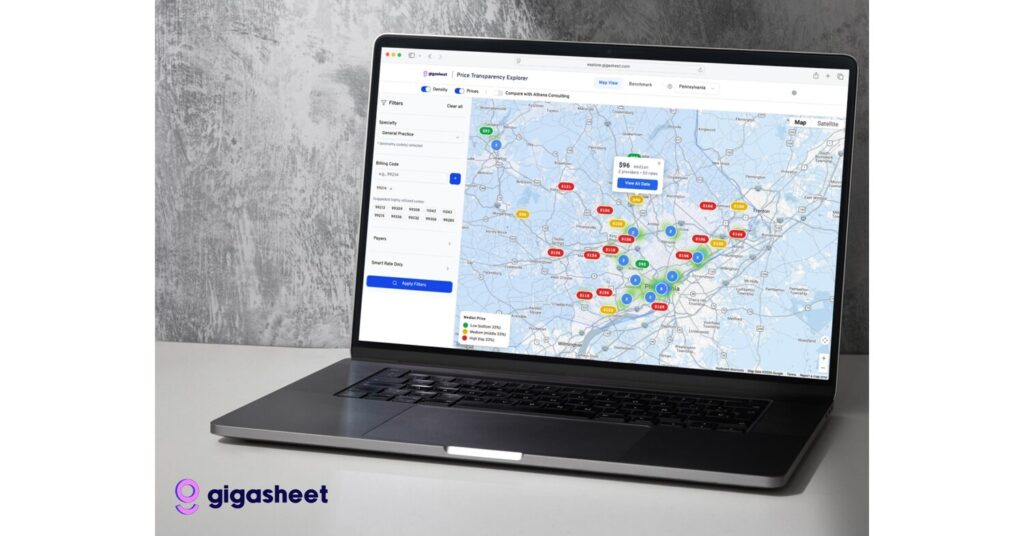
Healthcare price transparency data, required by law since 2021 and 2022, still remains underutilized by many organizations due to its inherent complexity, issues with data quality, and considerable processing challenges. Gigasheet, an AI-powered healthcare pricing intelligence platform, has attempted to bridge this gap with the introduction of Price Transparency Explorer, a tool designed to transform unwieldy price transparency data into actionable insights. This article will evaluate the capabilities of Gigasheet’s platform in relation to other automation and AI solutions available to small and medium-sized business (SMB) leaders and automation specialists.
The strength of Gigasheet lies in its ability to create interactive maps and visual comparisons that simplify the analysis of healthcare pricing. For the first time, users can perform side-by-side comparisons of health plans, revealing crucial differences in rate structures across various markets. This feature is aimed at payers, benefits consultants, and employers, allowing them to visualize their plan’s competitive standing. The efficacy of such a tool stems from its AI-driven Smart Rate, which ensures that comparisons reflect typical contracted rates. Consequently, the platform positions itself as a cost-effective solution that minimizes the need for extensive teams of data analysts, enhancing operational efficiency.
In contrast, other platforms such as Zapier offer robust automation capabilities across numerous applications. While Zapier enables users to automate workflows by connecting different applications, it may lack the depth required for nuanced industries like healthcare. Users in healthcare contexts often require specialized tools that can tackle specific data types and regulatory frameworks. Meanwhile, tools like Make also provide automation but with a user-friendly visual workflow designer. However, the challenge remains that they may not meet the intricate demands of healthcare pricing analysis.
When it comes to return on investment (ROI), Gigasheet presents a clear advantage. The platform not only provides immediate insights into pricing disparities but also offers future projections based on billing codes and payers. Such functionality can be invaluable for organizations looking to streamline healthcare costs. By minimizing the resources required for data analysis, Gigasheet enhances the bottom line significantly. In contrast, while automation platforms like Zapier and Make can optimize processes across a variety of applications, they may not directly contribute to savings in specialized contexts such as healthcare pricing.
Regarding scalability, Gigasheet’s infrastructure is designed to adapt to varying data loads and user needs. The platform’s emphasis on real-time analysis enables organizations to drill down to precise details without needing to export data to other tools. This seamless integration can greatly assist firms in scaling their operations as they grow. Tools like OpenAI and Anthropic serve as strong contenders in the AI space but focus primarily on natural language processing and broader AI applications, which may not fulfill the specific requirements for healthcare pricing transparency that Gigasheet is tailored to address.
Another point of comparison is the cost. Gigasheet’s AI-powered features, combined with its offerings for pricing transparency, potentially reduce the costs associated with data analysis, allowing companies to divert those resources elsewhere. In contrast, automation tools typically involve subscription models that may lead to escalating costs as more applications are integrated or as workflows become increasingly complex.
The predictive analytics capabilities in Gigasheet further bolster its appeal among SMBs. By providing not only historical data analysis but also projecting future trends based on current market conditions, Gigasheet empowers organizations to make informed decisions. Conversely, while OpenAI and Anthropic’s processing power can also provide insights, they may require additional layers of integration to serve specific needs in healthcare pricing analysis.
For organization leaders and automation specialists looking to adopt AI and automation tools, the takeaway is clear. Each tool comes with its own strengths and weaknesses, necessitating a careful evaluation based on specific business needs. Gigasheet’s focus on healthcare pricing transparency makes it a specialized choice for organizations operating in that domain. In contrast, more generalized automation tools like Zapier and Make are better suited for broader applications but may lack the specialization required for deep analysis in a niche market.
FlowMind AI Insight: In choosing an AI or automation platform, it is crucial for SMB leaders to assess the specificity of their needs in comparison with the tool’s capabilities. As evidenced by Gigasheet’s innovative approach to healthcare price transparency, specialized tools can offer greater insights and efficiencies, driving better outcomes for organizations navigating complex data landscapes.
Original article: Read here
2026-02-24 08:00:00