
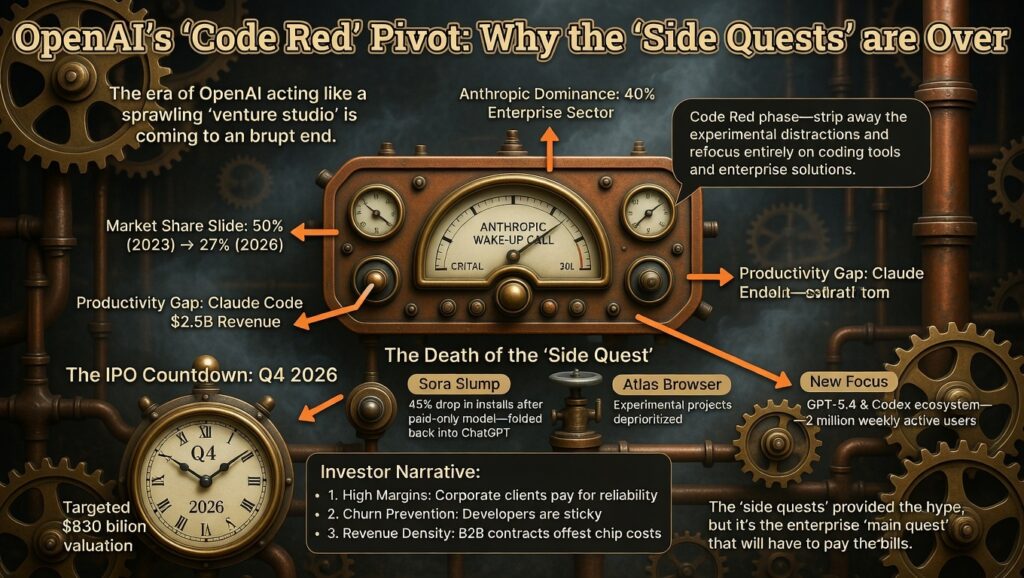
The landscape of artificial intelligence and automation is undergoing a significant transition, driven by rapid advances and increasing competition. A recent internal directive from OpenAI’s leadership indicates a strategic pivot from exploratory projects to focused initiatives aimed at enterprise solutions. As OpenAI recalibrates its focus, leaders in small and medium-sized businesses (SMBs) must recognize the importance of this shift when evaluating potential partners and platforms for AI and automation.
OpenAI’s reassessment stems from heightened pressure in the market, notably from competitors such as Anthropic. The latter has established a formidable presence in the enterprise sector, gaining nearly 40% market share, compared to OpenAI’s decline to 27%. These figures illustrate a pivotal moment in the industry, one that requires SMB leaders to be astutely aware of both the competitive landscape and the tools available for enhancing productivity through automation.
At the forefront of this shift is the need for tools that can deliver predictable and recurring enterprise revenue streams. OpenAI’s previous strategies involved a multitude of experimental projects, which, while innovative, detracted from its core value proposition. The pivot towards creating enterprise-focused tools signifies a recognition that businesses now prioritize reliability and security over novelty. This evolving market perspective implies that SMB leaders should assess AI tools not solely by their innovative features, but rather by their capacity to integrate smoothly into existing workflows and improve operational efficiency.
In comparing automation platforms, applications such as Make and Zapier exemplify the diverse offerings available. Make, known for its visual interface and powerful scenario-building capabilities, allows users to automate complex workflows with ease. On the other hand, Zapier’s strength lies in its extensive app integrations and user-friendly setup. However, its dependency on third-party APIs can lead to limitations in scalability when businesses grow and require more robust custom solutions. While Make may present a higher initial investment in terms of time and learning curve, its capabilities may yield a higher return on investment (ROI) in contexts where intricate workflows are a necessity.
On the AI front, the emerging competition between OpenAI and Anthropic highlights distinct approaches to market positioning and innovation. OpenAI’s tools, particularly within the Codex ecosystem, have demonstrated substantial user engagement with over 2 million weekly active users. However, Anthropic’s Claude Code triumphs in specific use cases, offering highly refined coding assistance and a streamlined user experience. As such, SMB leaders need to evaluate their unique requirements and match them with the strengths of these platforms. The critical factor should be whether the tool not only addresses immediate needs but also possesses the potential to evolve alongside the business.
As SMBs explore these platforms, considerations of scalability and ongoing costs will play a vital role in making informed decisions. Effective budgeting for AI and automation not only includes the software subscription fees, but also the infrastructure costs related to data processing and the potential need for custom integrations. For instance, while both OpenAI and Anthropic offer solutions that can significantly enhance productivity, the total cost of ownership over time—including updates and system maintenance—merits careful evaluation before committing to a platform.
The concept of “churn prevention” emerges as a valuable strategy for organizations investing in technology. The stickiness of a platform, or how well it becomes integrated into an organization’s routine processes, will directly influence its retention rate. Industry data suggests that businesses investing in AI integrations experience lower churn, fostering an environment where developers and teams become reliant on these critical tools. In this respect, understanding the user interface, support structure, and community around the chosen platform can enhance the likelihood of long-term satisfaction.
Investing strategically in AI tools is essential. OpenAI’s pivot towards established enterprise solutions and Anthropic’s recent success underline the need for SMB leaders to prioritize reliable platforms over experimental innovations. The previous distractions of “side quests” have made way for a more intentional focus on the “main quest”—realizing measurable productivity and operational efficiency through AI and automation. This evolution not only reflects market demands but also aligns with the growing expectations of stakeholders seeking long-term value in technology investments.
Finally, as leaders in SMBs chart their technology strategies, viewing AI and automation through a lens of scalability, productivity, and total cost of ownership will yield richer insights. By leveraging the right tools as part of their operational arsenal, organizations can effectively position themselves not just to survive but to thrive in an increasingly competitive landscape.
FlowMind AI Insight: As competitive pressures mount in the AI sector, SMB leaders must prioritize platforms that offer not only functionality but also seamless integration into their existing operations. Strategic investments will dictate long-term success in harnessing the full potential of automation and artificial intelligence.
Original article: Read here
2026-03-26 03:03:00