
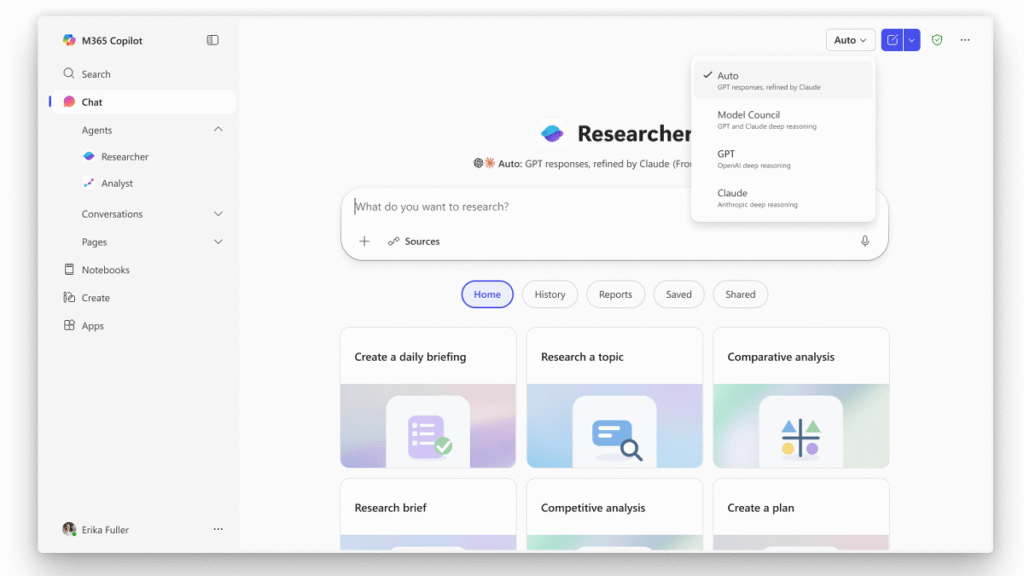
Microsoft’s recent enhancements to its AI offering, Microsoft 365 Copilot, have introduced new functionalities that could significantly impact small and medium-sized businesses (SMBs) and automation specialists. Notably, the introduction of multi-model capabilities within the Researcher function enables users to leverage two AI models simultaneously to generate high-quality reports. This feature is designed with versatility in mind, allowing users to run either OpenAI’s GPT or Anthropic’s Claude. With the implementation of an ‘Auto’ option, this functionality can now switch between draft creation and refinement processes, aiming to improve the overall output quality.
Comparing Microsoft 365 Copilot to other automation platforms, particularly in the realm of AI tools, reveals several strengths and weaknesses. For instance, Microsoft 365’s integration with existing enterprise infrastructure distinguishes it from standalone platforms like Zapier and Make, which primarily focus on simplifying workflow automation through app integrations. While these automation platforms boast user-friendly interfaces and extensive third-party integrations, they may not offer the depth of data analysis capabilities found in Copilot’s Researcher function. For SMBs embedded in the Microsoft ecosystem, the seamless integration of their internal data sources, such as emails, chat histories, and documents, amplifies Microsoft 365 Copilot’s value proposition.
However, the strengths of Microsoft 365 Copilot come with costs. The licensing fees associated with Microsoft 365 products are often higher than those of alternative automation tools. SMB leaders must weigh the financial implications of investing in Microsoft 365 Copilot against potential productivity gains. The initial cost might be justified by the enhanced reporting capabilities and the promise of improved decision-making efficiency that AI can offer. In contrast, platforms like Zapier and Make provide a lower cost of entry, particularly for businesses that require simpler automation solutions without deep analytics.
When considering return on investment (ROI), it is essential to ponder how effectively these platforms convert effort into results. Microsoft 365 Copilot’s multi-model functionality—particularly the ‘Critique’ and ‘Council’ modes—aims to enhance AI-generated outputs through collaborative processing. This could potentially decrease the time spent on report generation and analysis, which in turn may lead to quicker, more informed decision-making. However, the effectiveness of this system relies heavily on the quality of input it receives from users. Improved reporting is contingent upon accurate data and well-defined queries, which might require additional investment in user training or onboarding.
Conversely, platforms like Zapier are particularly strong in task automation and process efficiency, making them invaluable for operational tasks that do not require complex analytics. They can effectively connect disparate applications and automate routine tasks, thereby freeing up human resources for higher-value activities. Yet, when complex data analysis is required, reliance on these if ever so capable tools may yield limited insights compared to deeper AI integrations offered by Microsoft 365 Copilot.
Scalability is an additional consideration within the context of these platforms. Microsoft 365 Copilot’s integration into the larger Microsoft ecosystem ensures scalability, as businesses can easily adopt new features and capabilities as their needs evolve. SAPs like Zapier and Make can also scale; however, their effectiveness may diminish as businesses move toward more complex automation challenges that involve deeper contextual understanding of data. In environments where rapid transformation is a constant, Microsoft 365’s cohesive environment may provide a competitive edge.
In summary, while Microsoft 365 Copilot presents a robust option for businesses that prioritize data-driven decision-making and in-depth analysis, the costs associated with adoption must be carefully analyzed against expected productivity gains. Tools like Zapier and Make offer streamlined automation solutions at lower costs, emphasizing operational efficiency but possibly sacrificing analytical depth. SMB leaders need to evaluate the specific needs of their organization when choosing between these tools, with a focus on ensuring a balance between cost, scalability, and the specific analytical capabilities required for their competitive strategy.
FlowMind AI Insight: As SMBs navigate the evolving landscape of AI and automation, choosing the right platform will hinge on aligning operational needs with strategic objectives. Emphasizing thorough assessments of ROI, costs, and scalability will be critical in leveraging technology for sustained growth and efficiency.
Original article: Read here
2026-03-31 06:23:00