
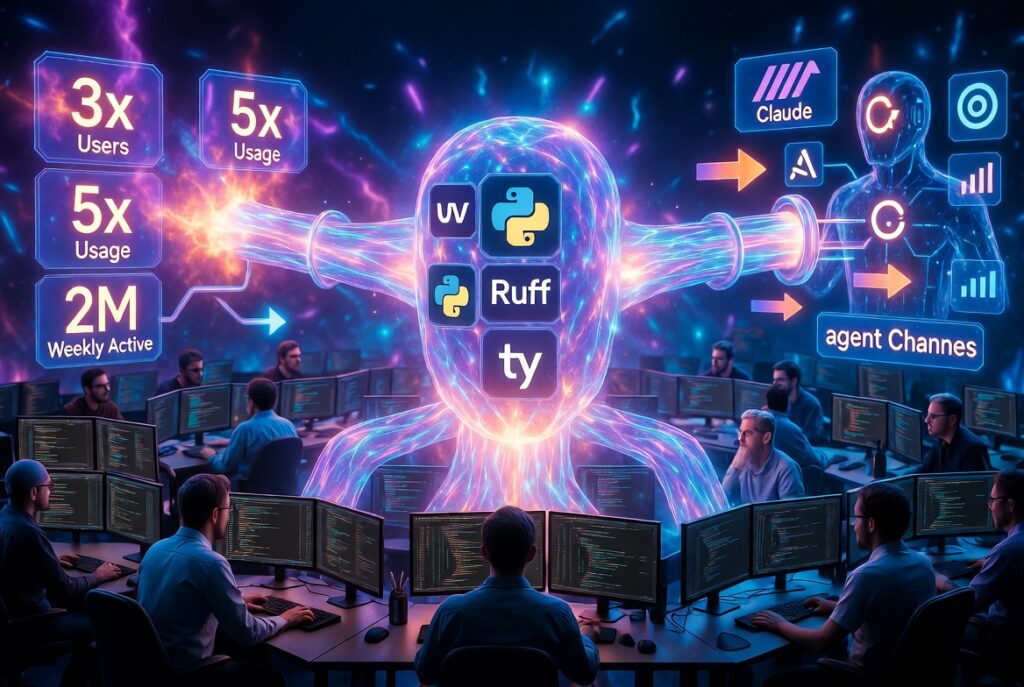
The landscape of AI and automation has recently shifted dramatically, as exemplified by OpenAI’s strategic acquisition of Astral. This move marks a significant investment in the infrastructure underpinning the developer experience, which includes popular tools such as uv, Ruff, and ty. Understanding the implications of this acquisition is crucial for SMB leaders and automation specialists who are navigating the evolving technological environment.
Focusing first on Codex, OpenAI’s coding platform, it has demonstrated remarkable growth in user engagement in 2026. The platform has experienced a threefold increase in users and a fivefold increase in usage since January, currently boasting over two million weekly active users. Such metrics signify not only popularity but also a growing dependence on AI tools within the developer community. The integration of Astral’s capabilities into Codex provides OpenAI with a unique advantage: the ability to offer a comprehensive AI coding environment directly within the tools developers are already using. This strategy could decisively alter workflows, making them more efficient and streamlined, thus directly impacting ROI for companies that adopt these technologies.
In contrast, Anthropic has emerged as a formidable player in the AI landscape, focusing on powerful autonomous agents, particularly with its Claude platform. Dario Amodei, CEO of Anthropic, succinctly stated that the company which constructs the most effective AI tool for programmers will dominate the field. Anthropic aims to create higher-level AI functionalities, integrating capabilities like remote control through messaging apps. While this approach offers considerable benefits—particularly in enhancing user engagement and the ability to multitask—it raises important questions about dependencies on specific platforms and the flexibility these systems allow.
A direct comparison emerges between OpenAI’s and Anthropic’s strategies. OpenAI is not merely developing an AI tool; it is building an entire ecosystem around it. By controlling foundational tools in the Python ecosystem, OpenAI positions itself as an essential player in daily developer routines. This level of ownership affords it the potential to make Codex an indispensable resource. The strong focus on infrastructure and the daily practices of developers offers a model that could serve as a scalable blueprint for long-term adoption.
While both platforms have unique strengths, they also possess distinct weaknesses. Anthropic’s focus on high-level autonomous agents may lead to challenges in widespread adaptability, as they can require more specialized knowledge and integration efforts. Conversely, OpenAI’s tools benefit from their established presence in the developer community, yet they might face scalability challenges if they do not evolve rapidly enough to meet diverse needs. It is pivotal to weigh these characteristics especially when considering cost: while OpenAI’s offerings may appear cost-effective in terms of immediate deployment, lengthy integration processes or limited flexibility could ultimately yield increased total costs.
When assessing ROI, developers and leaders must consider more than just up-front costs. The potential for increased productivity, reduced errors, and enhanced collaborative features plays an essential role in calculating true returns. OpenAI’s focus on addressing daily workflow needs may yield a higher ROI for teams looking to improve coding efficiency and reduce time spent on mundane tasks. In contrast, Anthropic could attract teams focused on sophisticated AI capabilities, notwithstanding the potential learning curve and integration overhead.
As we analyze the competitive landscape, it becomes evident that owning the developer’s chair will be crucial in determining the victor in this ongoing battle between automation platforms. The strategic placement of Codex within the developer ecosystem suggests that OpenAI places a premium on establishing a ubiquitous presence. This model elevates the conversation from merely having a superior model to cultivating an entire infrastructure that developers instinctively rely on.
Consequently, SMB leaders and automation specialists would benefit from establishing clear priorities when evaluating AI and automation platforms. The decision of which tool to adopt should consider not only current needs but also long-term strategic goals. Tools that align more closely with existing workflows may offer greater immediate rewards, whereas higher-level solutions could require a longer reach to achieve comparable effectiveness.
In conclusion, the future trajectory of software engineering and automation will not hinge solely on who produces the most powerful AI model. Instead, it will rely heavily on who can integrate their solutions seamlessly into the daily lives of developers, enhancing productivity while minimizing friction. As the competition heats up between OpenAI and Anthropic, the most prudent course for SMBs is to remain agile and informed, extracting maximum value from their chosen tools while preparing for inevitable changes in the market landscape.
FlowMind AI Insight: The current trend in AI and automation platforms emphasizes the importance of integration within existing workflows. As companies like OpenAI swiftly adapt and expand their toolsets, SMB leaders must stay vigilant and responsive, ensuring their technology choices align with both their immediate operational needs and longer-term strategic goals.
Original article: Read here
2026-04-03 06:03:00