
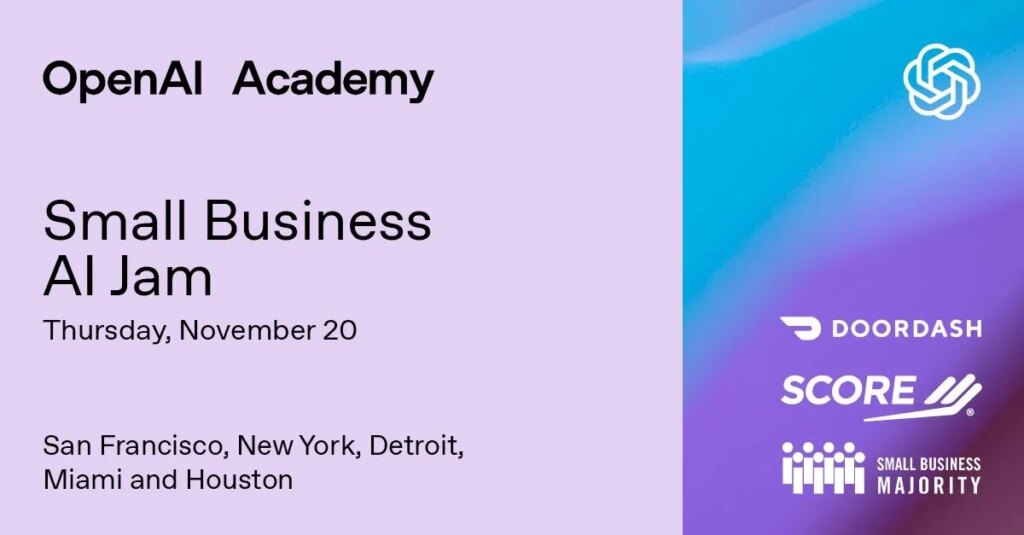
OpenAI Academy recently announced the launch of a nationwide initiative designed to assist small businesses in harnessing the power of artificial intelligence. The Small Business AI Jam, scheduled for November 20, aims to gather around 1,000 small business owners in cities like San Francisco, New York City, Houston, Detroit, and Miami for a day dedicated to hands-on collaboration. In partnership with DoorDash, SCORE Mentors, and Small Business Majority, the program focuses on making AI practical and accessible for everyday business operations.
The event will facilitate direct interaction between small business owners and OpenAI mentors. Participants will have the opportunity to create AI tools that suit their specific needs, such as automated social media planners for café owners or AI-driven scheduling assistants for salon owners. By the end of the workshops, each attendee will walk away with a tangible AI solution, as well as follow-up resources from OpenAI Academy, thereby ensuring that their newfound knowledge is actionable.
This initiative speaks to a larger trend in the small business landscape, where time and resource constraints often inhibit the adoption of innovative technologies. OpenAI maintains that small businesses are the backbone of local economies, yet many lack the technical know-how to implement AI solutions effectively in their daily operations. Workshops like the Small Business AI Jam aim to bridge this gap, providing the necessary tools and mentorship for small business owners to explore AI’s potential.
In today’s landscape, numerous AI and automation tools exist to support small businesses in their operations. For instance, platforms like Zapier and Microsoft Power Automate offer automation tools that enable users to connect various applications and streamline workflows. While both are robust options, they cater to slightly different user needs and scenarios.
Zapier is particularly user-friendly, designed for those who may not have extensive technical backgrounds. Its pricing model is tiered, allowing businesses to opt for either a free version with limited functionality or a paid tier that starts around $19.99 per month. Zapier integrates seamlessly with over 5,000 apps, making it a good choice for businesses looking to connect disparate software systems without deep technical knowledge.
On the other hand, Microsoft Power Automate tends to be more powerful for organizations already embedded in the Microsoft ecosystem. It allows greater customization and offers advanced features like AI Builder, which empowers businesses to create AI models tailored to their workflows. The basic pricing starts around $15 per user per month, but companies that already pay for Microsoft 365 usually find the tool more affordable due to bundled features.
When comparing reliability, both tools are dependable, but Microsoft Power Automate may offer better support for enterprise-level needs due to its integration with other Microsoft services. Zapier, while very reliable for simpler tasks, can face limitations when automating complex workflows.
When integrating Zapier, the process typically involves creating “Zaps,” which are automated workflows connecting different apps. Users can select triggers and specify actions based on those triggers. However, complete migrations can require some planning around app compatibility. A typical low-risk pilot would involve automating a single process—perhaps automating the lead capture from a web form into a CRM—before fully committing to a broader implementation.
Conversely, migrating to Microsoft Power Automate may require a more complex setup, especially for businesses not familiar with Microsoft services. The pilot process can begin by automating an internal process—like syncing data between SharePoint and Excel—allowing teams to understand how Power Automate can best streamline their existing workflows.
Both tools have their specific limits and ideal scenarios. If a small business needs quick automation for their marketing tasks and doesn’t require extensive customization, Zapier could be the better option. However, if the organization is already leveraging Microsoft tools and needs complex automation with advanced features, Microsoft Power Automate would be the recommended choice.
Regarding the total cost of ownership, businesses must consider the monthly subscription fees along with potential training or onboarding costs. For instance, with Zapier, the total cost may remain low, especially for small teams unsure about extensive automation. Alternatively, Microsoft Power Automate’s initial costs may seem higher, but the advanced capabilities could yield greater ROI through efficiency gains over time. In a typical scenario, businesses can expect to see measurable ROI within three to six months by streamlining their workflows, leading to increased productivity and lower operational costs.
FlowMind AI Insight: Investing in AI and automation tools is not just a future-forward strategy; it is essential for small businesses aiming to remain competitive. By choosing the right platform tailored to specific operational needs, small business owners can not only increase efficiency but can also unlock new avenues for growth, defining a better trajectory for their future.
Original article: Read here
2025-10-16 07:00:00