
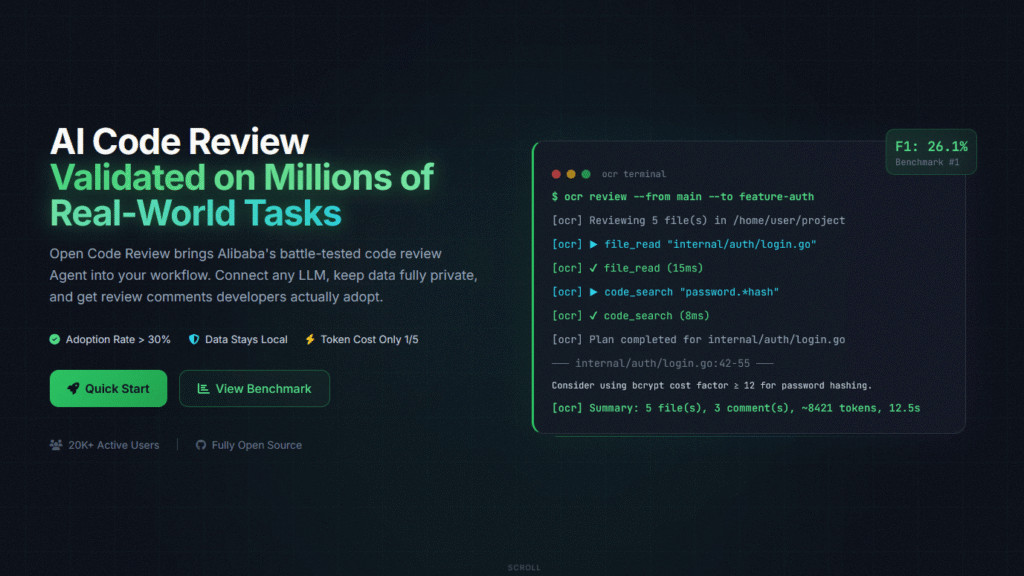
Software development is evolving rapidly, with AI agents taking center stage in processes like code reviews. Large enterprises, like Alibaba, are leveraging advanced AI systems to address the challenges of traditional code reviews. Their system, Open Code Review, has become a game changer by enhancing the quality and reliability of code evaluations. As small and medium-sized businesses (SMBs) consider adopting AI tools like Open Code Review, it’s important to compare them with other solutions available in the market, such as Claude Code.
Both Open Code Review and Claude Code are designed to assist developers by automating code evaluation processes. Open Code Review stands out for its focus on engineering logic rather than language model-based logic, which can lead to oversight and inconsistencies in traditional AI code reviews. According to Alibaba, its system has already detected over one million code defects, showcasing its substantial impact on code quality. Its deterministic approach ensures comprehensive reviews, addressing issues like positional misalignment and unstable quality found in existing AI code reviewers.
In contrast, Claude Code, while a competent tool with a user-friendly interface, sometimes falls short in terms of depth and reliability. Developers using Claude may experience variations in output quality based on minor changes to prompts, which can lead to inconsistent review results. This inconsistency can be detrimental for SMBs that may not have the resources or expertise to re-evaluate code multiple times.
When evaluating these two options, features such as token usage become crucial. Open Code Review reduces token consumption to one-fifth compared to Claude Code, making it a more cost-effective solution for businesses concerned about operational costs as they scale. Additionally, Open Code Review allows users to work with any AI model, further enhancing its flexibility and adaptability.
Pricing structures play a significant role in choosing an AI tool. Open Code Review is open-source, available on GitHub, which means businesses can leverage the technology without incurring direct licensing fees. On the other hand, Claude Code typically operates on a subscription model that can add up, particularly for smaller teams with limited budgets. Such financial considerations are critical for SMBs that must manage tight budgets while seeking effective solutions to enhance productivity.
Integration potential is another factor to consider. Open Code Review is designed to function seamlessly within the existing workflows employed by developers. Given its open-source nature, customization possibilities are extensive, allowing teams to tailor the tool to fit specific processes and needs. In contrast, Claude Code features integrations with popular IDEs but offers limited customization options, which could be a barrier for organizations seeking a more bespoke solution.
Support resources can greatly influence user experience. Open Code Review, being part of an open-source community, involves a collaborative approach to problem-solving, potentially offering diverse solutions but might lack the structured support found in commercial products. Claude Code provides dedicated support channels but tends to be slower in response time, which can be a significant concern in environments where timely feedback is essential for productivity.
For SMBs considering transitioning to AI-assisted code reviews, a low-risk pilot using either Open Code Review or Claude Code can be implemented by selecting a small segment of code to evaluate. By running both tools in parallel, businesses can compare results and identify the most reliable tool for their specific environment without impacting larger projects. Migrating to Open Code Review involves minimal disruption due to its flexibility and compatibility with existing systems, whereas transitioning to Claude Code may require more extensive adjustments in workflows.
In terms of total cost of ownership, businesses choosing Open Code Review can expect lower ongoing expenses due to its open-source nature. However, initial implementation might require some investment in training and adjustments. Expected ROI over a three to six-month period is promising. By improving code quality and reducing errors, companies can minimize downtime and enhance productivity. Similarly, while Claude Code entails recurring fees, its potential to streamline processes may justify the costs for organizations needing consistent output with less focus on customization.
FlowMind AI Insight: As SMBs look toward implementing AI-driven coding tools, knowing the strengths and weaknesses of Open Code Review and Claude Code is crucial. Choosing the right tool involves understanding operational needs and budget constraints, supporting informed decisions that lead to better code quality and enhanced efficiency. Both tools offer their unique advantages, but thorough research and pilot testing can illuminate the most suitable choice for any SMB’s coding environment.
Original article: Read here
2026-06-07 10:53:00