
AI agents have transitioned from being mere concepts and experimental prototypes to becoming essential tools for businesses, paving the way for a new realm of automation and efficiency. As companies dedicate increased resources to enhance the utility of AI agents, understanding the comparative strengths and weaknesses of leading platforms becomes crucial for SMB leaders and automation specialists seeking to maximize ROI and scalability.
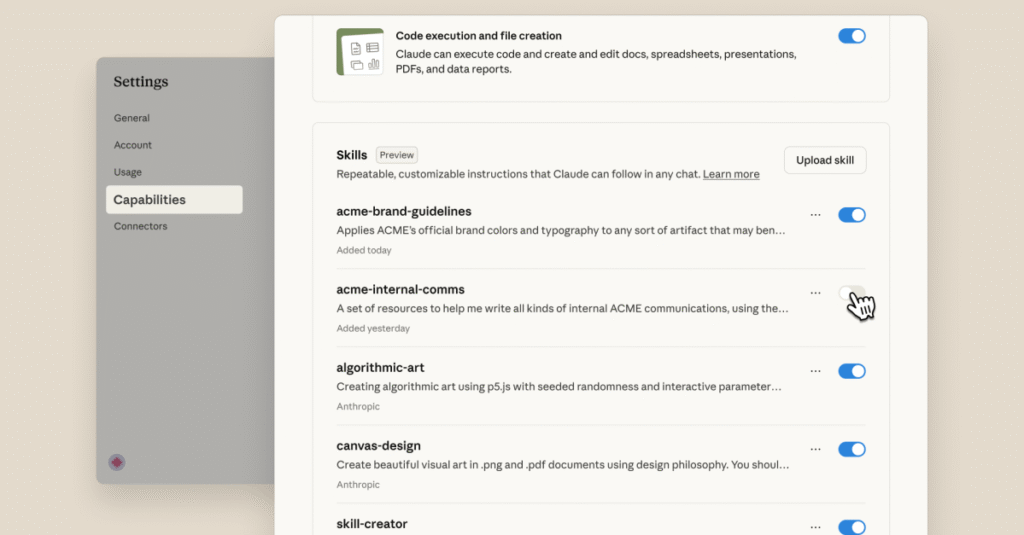
Recently, Anthropic introduced its latest innovation, ‘Skills for Claude,’ targeting specific work tasks like managing Excel or adhering to brand guidelines. This feature allows users to build custom skills tailored to their organizational needs, effectively enhancing Claude’s capabilities with a user-centric focus. Enterprises like Box, Rakuten, and Canva have already leveraged the tool to streamline their workflows. The core advantage of Skills for Claude lies in its adaptability; it not only caters to general tasks but also enables customized configurations for specific job functions. This tailored approach reduces the need for elaborate prompting, allowing teams to focus on high-value tasks.
In contrast, OpenAI has taken a different route with AgentKit, a suite of tools designed to transition agents from prototype stages to fully operational entities. The emphasis here seems to be on creating robust, data-driven agents that can handle complex business requirements, as demonstrated through its use case with Albertsons to enhance ice cream sales when performance dips. While the AgentKit offers companies the flexibility to integrate data and produce tangible business outcomes, it may pose a higher barrier to entry given its focus on broader use cases rather than granular customization.
When comparing both platforms, a notable strength of Skills for Claude is its user-friendly ability for organizations to teach Claude how to operate in specific contexts. As product lead Brad Abrams articulates, the flexibility to accommodate unique organizational requirements caters to diverse tasks without getting mired in abstract performance benchmarks. Conversely, AgentKit appears to lean towards establishing an extensive infrastructure to develop fully functional agents, which may require significant investment in time and resources.
Cost structures remain a critical consideration. Claude’s offerings, available for Pro, Max, Team, and Enterprise users, might appeal to smaller organizations that require a more straightforward implementation and scaling process. The reduced complexity helps mitigate risks associated with iterative agent development, particularly for SMBs with limited budgets. On the other hand, the investment in OpenAI’s AgentKit could yield higher upfront costs. Still, this may be justified by its capacity to deliver sophisticated outcomes for well-resourced enterprises looking to scale their operations.
Evaluating the return on investment (ROI) impacts relies on how these tools align with organizational needs. Skills for Claude enables rapid deployment of customized skills, which could lead to immediate productivity gains for businesses looking to optimize existing workflows. The ease of implementation may produce swifter financial returns, especially for SMBs. In contrast, while AgentKit may present larger upfront costs and require deeper organizational commitment, organizations willing to invest in its comprehensive capabilities could realize more profound long-term benefits, especially if they handle extensive data processing and analytics.
Scalability also presents a vital point of differentiation. Claude’s modular skills format lends itself to more agile scaling for organizations in fast-paced environments, adapting swiftly to changing business requirements. This agility can significantly enhance speed to market, a crucial advantage in competitive sectors. Conversely, AgentKit’s more structured approach might appeal to larger organizations with established operational frameworks, where the scalability of more intricate, custom workflows can lead to high-stakes strategic advantages.
In summary, both Anthropic and OpenAI offer valuable tools with distinct advantages. Skills for Claude emerges as an ideal choice for SMBs seeking tailored solutions that require low overhead and rapid deployment. Meanwhile, AgentKit may serve larger organizations aiming for comprehensive solutions that integrate extensive data processing capabilities with a focus on maximizing productivity in the long run. A business’s specific context, resource availability, and operational structures will dictate which platform best serves its objectives.
FlowMind AI Insight: As organizations strive to harness the power of AI agents, the decision between tools like Claude and AgentKit will hinge on balancing immediate utility against long-term strategic vision. Tailoring solutions to fit specific business needs while ensuring room for scalability can yield effective automation that drives competitive advantage.
Original article: Read here
2025-10-16 16:00:00