
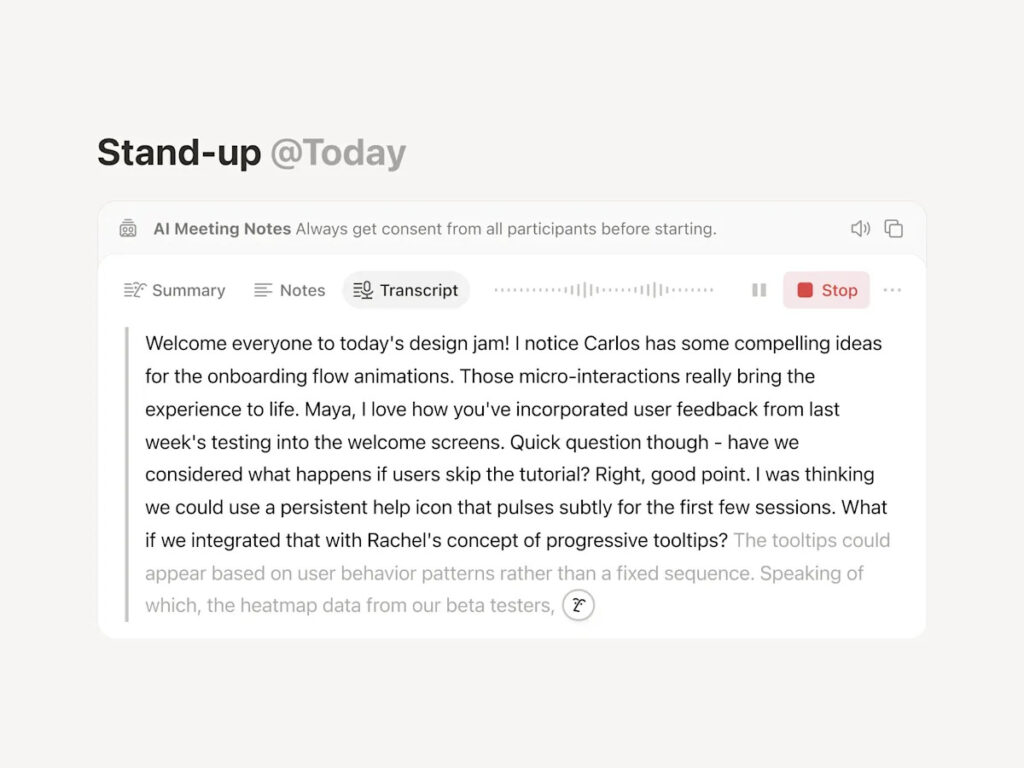
Notion’s recent announcement about enhancing its AI capabilities marks a significant development in the productivity landscape, particularly as it aims to compete with established tools like Otter.ai. Businesses, especially small and medium-sized enterprises (SMBs), need to understand the implications of these changes and how they can leverage such technology for optimal efficiency.
Notion now offers AI Meeting Notes, a feature that transcribes and summarizes conversations right within the app. Unlike Otter.ai, which is dedicated solely to voice transcription and meeting minutes, Notion AI integrates this functionality directly into its broader suite of productivity tools, allowing users to interact with meeting notes as part of their existing projects. This might appeal to teams using Notion as their primary workspace, as it streamlines the workflow by keeping everything in one place.
Integrations are another area where Notion shines. Users can connect Notion to various platforms like Slack, Google Workspace, and GitHub, allowing them to search for information across those apps using natural language queries. For example, a user might query, “What’s the latest on our client project?” and receive relevant results pulled from multiple sources. Otter.ai, while reliable for transcription, does not offer such extensive integrations, making it less flexible in a multi-tool environment.
Pricing structures also contrast significantly. Notion’s Business plan will increase from $15 to $20 per month per user but will now include unlimited access to its AI features, removing the need for a standalone subscription for AI. This presents a compelling argument for organizations already using Notion or planning to adopt its platform. Conversely, Otter.ai’s pricing model is typically based on a monthly or annual fee for transcription services, which could add up when multiple users require access. For teams heavily invested in Notion’s ecosystem, the all-in-one pricing model presents a clear cost-benefit advantage.
Reliability is crucial for any business tool. Both Notion and Otter.ai have built a reputation for dependable service, but Notion’s recent updates extend its functionality beyond simple transcription. For specialized transcription needs, such as verbatim court reporting or detailed meeting minutes, Otter.ai remains a strong choice. However, for teams that also require project management and document collaboration, Notion could prove more effective.
In terms of support, both platforms offer robust customer assistance, but they vary in depth depending on the plan. Notion dedicates resources to help business users migrate their data from other platforms, making the transition smoother. Businesses should prepare for this process by identifying key information that needs to be migrated, training employees on the new tools, and using Notion’s migration resources effectively. A low-risk pilot could involve a small group within the organization testing the tools and features before a full-scale deployment.
Total cost of ownership is an important factor when selecting a productivity tool. With Notion’s new pricing model, organizations can estimate their costs based not only on the number of users but also the additional features, like AI Meeting Notes. In contrast, potential users of Otter.ai should consider ongoing subscription costs for each user requiring transcription services. The expected return on investment (ROI) for adopting Notion could manifest in significant time saved through streamlined workflows, likely adding up to improved project turnaround times within three to six months.
FlowMind AI Insight: The evolving landscape of AI-driven productivity tools presents SMBs with a unique opportunity to streamline operations. The choice between platforms like Notion and Otter.ai depends on specific organizational needs, existing workflows, and cost considerations. Notion’s all-encompassing features and integrations could be particularly beneficial for teams looking to consolidate their tools, while Otter.ai’s specialized transcription capabilities serve particular use cases effectively. Whichever option is chosen, the potential for improved productivity and efficiency is clear.
Original article: Read here
2025-05-13 07:00:00