
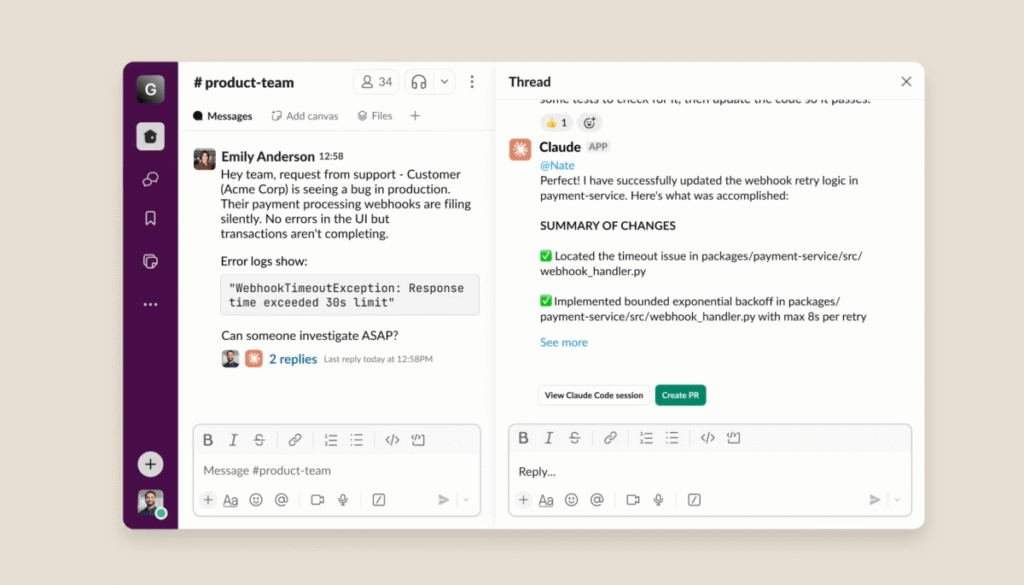
Anthropic’s recent launch of Claude Code within Slack marks a pivotal moment in the evolution of AI coding assistants. By enabling developers to delegate coding tasks directly through chat threads, this beta feature represents an extensive shift from lightweight coding assistance to a more holistic workflow automation system. This transition aligns with a broader trend in the AI landscape, where the focus is increasingly on enhancing operational workflows rather than merely improving the underlying model capabilities.
Previously, developers interacted with Claude primarily for provide cursory coding help, such as writing snippets, debugging code, or seeking explanations for specific challenges. The introduction of Claude Code allows them to tap into Slack’s collaborative environment more robustly. Developers can now utilize contextual information from previous messages to initiate complete coding sessions without leaving their primary communication platform. This seamless interaction—where developers can tag @Claude and receive comprehensive updates regarding bug reports or feature requests—may redesign the way coding gets incorporated into team dynamics.
The competitive landscape of AI coding assistance includes well-regarded players like GitHub Copilot and Cursor. GitHub Copilot, known for its sophisticated integrations, has recently added features that generate pull requests directly from chat, making it an appealing choice for streamlined code management. Meanwhile, Cursor enables developers to draft and debug code in Slack threads, expanding the ways teams can leverage their coding initiatives directly within their communication flows. Comparatively, OpenAI’s Codex can be accessed via bespoke Slack bots, providing a flexible approach tailored to teams’ specific needs. While all these platforms offer innovative solutions, the real differentiator is their level of integration with existing workflows.
Cost considerations pose another critical factor in decision-making for SMB leaders and automation specialists. The return on investment will greatly depend on the specific needs of each organization. For smaller teams or startups, more affordable solutions with basic functionalities may suffice, allowing for greater resource allocation elsewhere. In contrast, larger organizations may find that the investment in more sophisticated integrations pays dividends through increased productivity and enhanced collaboration. Therefore, an analysis aimed at understanding usage trends, team size, and project complexity will be essential in determining the right tool.
Scalability is another area where the various platforms diverge. Slack’s adaptability as a central communication tool allows for rapid scaling of functionalities, making Claude Code particularly appealing for organizations with growth potential. By fostering a coding environment directly within an established communication platform, teams can harness existing workflows rather than building new ones from the ground up. In contrast, while platforms like GitHub Copilot are powerful, any expansions of functionality require integration within the GitHub ecosystem, potentially complicating transitions as teams scale. In this sense, the broader flexibility of Claude Code could provide a compelling option for organizations navigating rapid expansion.
However, the rise in embedded AI tools does not come without risks. As teams become more reliant on platforms like Slack and Claude, questions surrounding code security and intellectual property protection arise. With sensitive repository access now having to be managed such that it can be reached via additional platforms, the potential for data breaches or lapses in security protocols increases. Moreover, the dependency on third-party APIs introduces vulnerability; functionality could be compromised by outages or service limitations, meaning that teams lose the local control they previously enjoyed. The ramifications of such issues could significantly disrupt development processes, a cautionary tale for organizations considering advanced tool integrations.
As Anthropic prepares for broader rollout, the timing aligns strategically with an increasingly competitive AI coding market. The differential between various platforms now hinges less on raw capabilities and instead focuses on the depth of integration with existing team workflows. Those companies that can adeptly mold their AI tools to fit seamlessly within existing operational frameworks will likely take the lead in not only developer satisfaction but also overall product success in the marketplace.
In summary, as embedded AI solutions like Claude Code emerge, SMB leaders and automation specialists must evaluate not just the capabilities of these systems, but how well they integrate into existing workflows and team dynamics. The choices made today will influence the agility, productivity, and security of coding operations for years to come.
FlowMind AI Insight: The intersection of AI tools and collaborative platforms signifies a transformative era in software development. Organizations must carefully assess not only the technical capabilities of these solutions but also their potential impact on team structure and productivity to harness their full benefits.
Original article: Read here
2025-12-08 19:18:00