
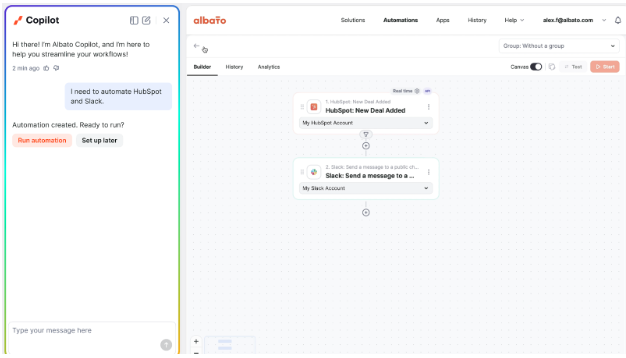
Albato, a prominent player in the no-code integration platform landscape, has introduced Albato Copilot, an AI-powered assistant designed to facilitate the automation of business processes through natural language interactions. This release signifies a transformative advancement in the automation market, particularly relevant for small and medium-sized business (SMB) leaders and automation specialists navigating increasingly complex integration landscapes. The tool positions itself against established competitors like Zapier and Make, raising the stakes in terms of ease of use, efficiency, and scalability.
The launch of Albato Copilot comes at a time when 73% of Software as a Service (SaaS) companies face challenges related to integration development costs and complexity. Indeed, the automation market is projected to surge to $39.9 billion by 2030, underscoring the urgent need for effective, accessible, and scalable automation solutions. Albato Copilot offers a response to this demand by enabling users to set up integrations in a fraction of the time—reportedly cutting setup time by 75% to 85%.
One of the primary strengths of Albato Copilot lies in its natural language interface. Users can articulate their automation requirements with simple prompts, such as requesting a Slack alert when a high-value lead fills out a contact form. This contrasts sharply with platforms like Make, which require a more manual and often cumbersome configuration process. While Make offers flexibility and control over integrations, the learning curve and complexity may deter non-technical users. In this context, Albato Copilot enhances user accessibility by allowing all employees, regardless of technical proficiency, to design workflows through conversational inputs.
In terms of financial investment, Albato’s proposition may appear initially more appealing to SMBs. While pricing structures vary across platforms like Zapier, which charges based on the number of tasks processed per month, Albato’s model is aimed at democratizing access to automation features without excessive operational costs. This targeted approach may improve return on investment (ROI) for businesses looking to scale their automation efforts without incurring heavy technical debt.
While Albato boasts significant upsides, it is essential to also consider potential weaknesses. For instance, the platform’s reliance on a large language model for interpreting user requests may introduce unpredictability in certain complex scenarios that involve multiple conditional logic layers. Competing tools such as OpenAI or Anthropic offer robust AI capabilities, but their focus lies in broader applications beyond automation, which could lead to enhanced performance and customization in niche areas. In contrast, Albato Copilot targets specific automation needs, potentially sacrificing some of the nuanced capabilities seen in larger, more complex systems.
Another advantage of Albato Copilot is its commitment to security and compliance. With SOC 2 Type II certification and full GDPR compliance, users can rest assured that their sensitive data remains protected. The platform also allows users to edit and modify existing automations, enhancing flexibility and adaptability. Despite this feature, users of Zapier may find its library of integrations broader due to its longevity in the market. Hence, for organizations with established workflows already integrated into Zapier, transitioning to Albato Copilot may entail additional costs in terms of time, training, and potential operational downtime.
Scalability remains a key consideration for SMBs assessing automation platforms. While Albato enables the creation of workflows involving over a thousand applications and provides continuous learning from user interactions, it will need to demonstrate this scalability over time, especially for larger enterprises that might have more intricate requirements. Comparatively, Zapier has a track record of evolving alongside its users, often adding new integrations promptly based on market demands.
It is worth noting that Albato Copilot stands out in its focus on user experience, featuring intelligent memory management and a built-in support assistant. The system’s capability to communicate in multiple languages reflects an understanding of diverse user needs and aims to foster a more inclusive automation environment. However, as competitors such as Make and Zapier enhance their customer service mechanisms, Albato will need to sustain an edge to ensure its continued growth and appeal.
As businesses increasingly look to leverage automation to improve efficiency, the decision on which platform to adopt should be grounded in a thorough evaluation of individual organizational needs. Factors such as the technical background of the workforce, existing integrations, ease of use, and long-term scalability should guide the choice of tool. By prioritizing platforms like Albato Copilot that prioritize user accessibility while addressing security concerns, companies can ensure a smoother integration of automation into their operations.
FlowMind AI Insight: In the evolving landscape of business automation, accessibility and user experience are paramount. As platforms like Albato Copilot strive to bridge the gap between technical complexity and user-friendliness, organizations stand to gain significantly from embracing these innovations, provided they align with their unique needs and operational frameworks. The focus should always be on leveraging the right tools to foster operational efficiency and strategic growth.
Original article: Read here
2025-12-01 18:18:00