
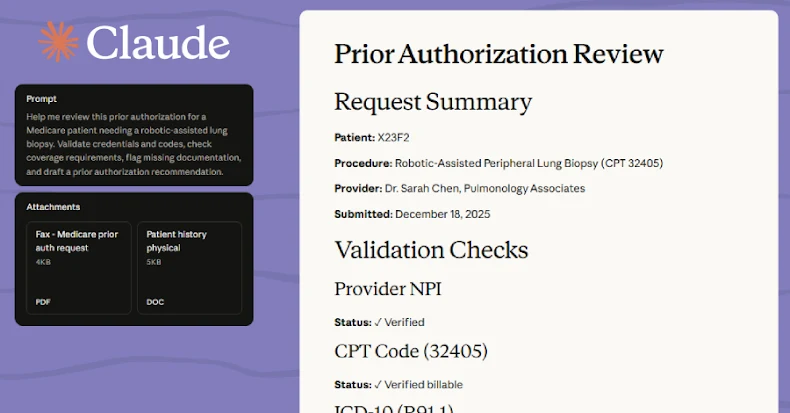
As we forge ahead into the new era of artificial intelligence, the healthcare sector is becoming increasingly ripe for disruption by AI-driven platforms. Notably, Anthropic and OpenAI have emerged as frontrunners in providing innovative solutions designed to empower patients and enhance healthcare delivery through their respective platforms, Claude and ChatGPT Health. Both companies have introduced features aimed at streamlining access to health information, ultimately seeking to foster more productive conversations between patients and healthcare providers.
Anthropic’s introduction of Claude for Healthcare illustrates a strategic response to various market needs. They are enabling U.S. subscribers of Claude Pro and Max to connect their lab results and health records securely through integrations with HealthEx and Function, with further interoperability features extending to Apple Health and Android Health Connect. This comprehensive approach allows Claude to summarize medical histories, clarify test results in accessible language, and identify patterns among various health and fitness metrics. Ultimately, the objective is to enable users to engage more effectively with healthcare professionals, rather than simply relegating AI to a passive role in information retrieval.
On the other hand, OpenAI has concurrently rolled out its ChatGPT Health platform, also emphasizing secure connections to medical records and wellness applications. OpenAI’s offerings enable users to receive tailored responses, insights on lab results, nutrition advice, and even meal planning suggestions. While both platforms exhibit remarkable capabilities, a side-by-side analysis underscores the nuanced distinctions between them.
From a cost structure perspective, both Anthropic and OpenAI have employed subscription pricing models, appealing to a broad range of users, including small and medium-sized businesses (SMBs) that are increasingly seeking automation tools to enhance operational efficiencies. While specific pricing details may fluctuate based on features and user volumes, the value proposition remains clear: The overall ROI from implementing these tools can be significant, considering the potential reduction in time spent on administrative healthcare tasks and improved patient engagement. However, organizations must also consider the ongoing costs associated with maintaining and securing data, which can escalate depending on the complexity of integrations and scale of usage.
In terms of scalability, both platforms present distinct strengths. Anthropic’s Claude is designed with a focus on a robust privacy framework, underpinning its architecture with explicit user controls regarding data sharing. This transparency can foster greater trust, especially in industries like healthcare where the sensitivity of data is paramount. OpenAI, while similarly committed to privacy, has had recent challenges related to the accuracy of health information generated by its models, which may affect user confidence. Scalability does not merely hinge on the ability to handle increasing loads; it also relies on maintaining quality and accuracy in outputs.
Despite their impressive capabilities, one must scrutinize potential weaknesses. Both platforms have been met with skepticism regarding potential misinformation and the inherent risks of substituting AI-driven insights for professional healthcare advice. Google recently faced backlash for inaccuracies in its AI health summaries, prompting platforms like OpenAI and Anthropic to emphasize that AI should complement, rather than replace, qualified healthcare providers. The continual evolution of AI means that businesses adopting these tools should remain vigilant and prioritize robust guidelines and oversight in high-risk areas like healthcare.
To optimize outcomes from deploying these platforms, SMB leaders and automation specialists must engage in thorough analysis prior to implementation. Clear objectives for what the organization seeks to achieve should underpin the choice of platform. For instance, businesses that prioritize patient engagement may benefit more directly from Anthropic’s Claude with its advanced personalized features designed for healthcare dialogue. Conversely, organizations seeking broader applications across wellness and nutrition may find OpenAI’s ChatGPT Health more suitable due to its multifaceted offerings and adaptability.
In conclusion, as the landscape of AI and automation continues to evolve, healthcare leaders must balance the clear benefits these technologies present with an acute awareness of their limitations. Both Anthropic and OpenAI have established themselves as comparably strong contenders in the market, yet the choice between them should hinge on the specific needs and objectives of the organization. Engaging with these platforms not only enhances operational efficiencies but also serves as a crucial step toward enhanced patient care, provided that adequate safeguards and human oversight remain integral parts of the process.
FlowMind AI Insight: The future of AI in healthcare lies in its ability to enhance human judgment rather than supplant it. Small and medium-sized businesses should prioritize platforms that align with their strategic goals, ensuring that both the potency of AI capabilities and the irreplaceable value of professional medical expertise are cohesively integrated.
Original article: Read here
2026-01-12 08:37:00