
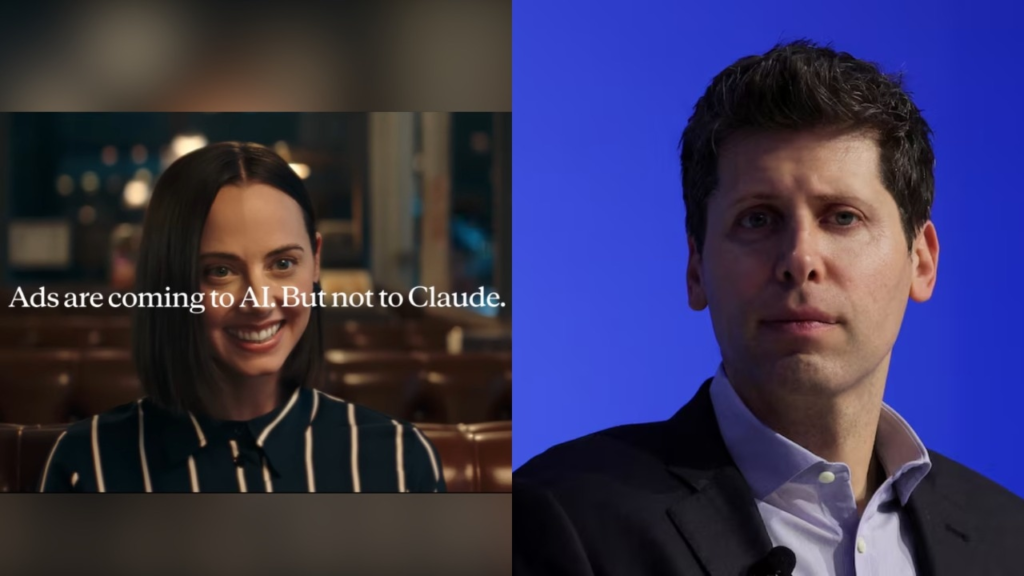
The competition among artificial intelligence companies has intensified, particularly with the recent developments between OpenAI and Anthropic. Anthropic’s deployment of four commercials on YouTube, including the strategic placement of one during the Super Bowl, illustrates a multifaceted marketing approach that emphasizes user engagement while subtly challenging OpenAI’s monetization strategies. By portraying its AI, Claude, as a non-intrusive alternative to ChatGPT, Anthropic positions itself in direct contrast to OpenAI’s move to integrate ads into its platforms, an act that has already drawn mixed reactions from users and industry players alike.
Anthropic’s commercials depict an AI in a human-like form offering sound advice across various topics, from personal relationships to business ideas. Initially, it engages the viewer with practical insights. However, the narrative quickly shifts toward a promotional tone, leading potential users to a state of confusion – this reflects a strategic critique of OpenAI’s conventional advertising model. The catchphrase “Ads are coming to AI. But not to Claude” encapsulates this marketing tactic effectively, projecting Claude as an ad-free solution.
In a rebuttal, OpenAI CEO Sam Altman responded to Anthropic’s advertisements with a blend of humor and critique. He acknowledged the comedic aspect of the commercials but labeled them as “dishonest,” arguing that OpenAI would never employ ads in such a deceptive manner. His comments evoke George Orwell’s concept of doublespeak, suggesting that Anthropic, by critiquing theoretically misleading advertising, resorts to exactly that which they claim to oppose. This strategic dissent highlights differing corporate philosophies encompassing user experience and advertising ethics within the AI sector.
At the heart of this competition lies not just a battle of metaphors but a fundamental divergence in business models and user engagement strategies. OpenAI aims to broaden its reach, targeting diverse user demographics with the intention of democratizing access to sophisticated AI technology. This ambition is illustrated by Altman’s assertion that ChatGPT enjoys a user base in Texas alone larger than that of all Claude users across the United States, which emphasizes the scalability and reach of OpenAI’s strategy. The cost of OpenAI’s subscription model is positioned to cater to a mass market, where lower entry barriers are key to fostering a broader adoption of AI technologies.
Conversely, Anthropic’s approach appears to cater to elite markets, offering a premium price point that emphasizes quality over quantity. This positioning can attract businesses willing to invest in a specialized product tailored for high-stakes applications, yet it raises questions regarding its long-term sustainability. As AI continues to mature, the ability to sustain high pricing in a rapidly diversifying market may prove challenging.
The conversation also delves into operational practices that may impact scalability and user adoption. Altman’s comments regarding Anthropic’s restrictive policies—such as blocking competitor access to its models on platforms like AI coding services—indicate a protective approach that could stifle broader collaboration and innovation. Such strategic decisions can also resonate with users who might see this as limiting their growth potential within the AI ecosystem. In contrast, OpenAI appears to adopt a more open stance, enabling collaborations that can lead to enhanced functionality for its user base.
While the advertising debate unfolds, it provides a broader commentary on how AI companies can learn from each other’s strengths and weaknesses. For instance, OpenAI’s extensive user engagement through community-driven insights and iterative feedback loops could serve as a model for Anthropic, which might establish a more inclusive dialogue with potential users about their ad-free platform’s specific advantages.
On the other hand, Anthropic’s focus on premium services can serve as a reminder for OpenAI to protect its brand integrity and user trust. The balance between monetization and ensuring a respectful user experience is delicate and must be navigated carefully.
In conclusion, as the landscape of AI and automation platforms evolves, businesses are faced with critical choices that will define their operational capabilities and user engagement strategies. Adopting lessons from these leading players can help small to mid-sized business leaders and automation specialists make informed decisions about which platforms align best with their strategic goals. Metrics such as user growth, pricing models, and operational scalability should weigh heavily in these choices, guiding investment toward technologies that not only demonstrate promise today but also exhibit the agility to adapt to future demands.
FlowMind AI Insight: In this fast-evolving AI landscape, it is crucial for SMB leaders to evaluate the strategic positioning of AI tools based on user experience, scalability, and pricing models. By discerning the competitive advantages of platforms like OpenAI and Anthropic, organizations can make informed decisions that align with their operational goals and ultimately drive long-term success in automation.
Original article: Read here
2026-02-05 04:41:00