
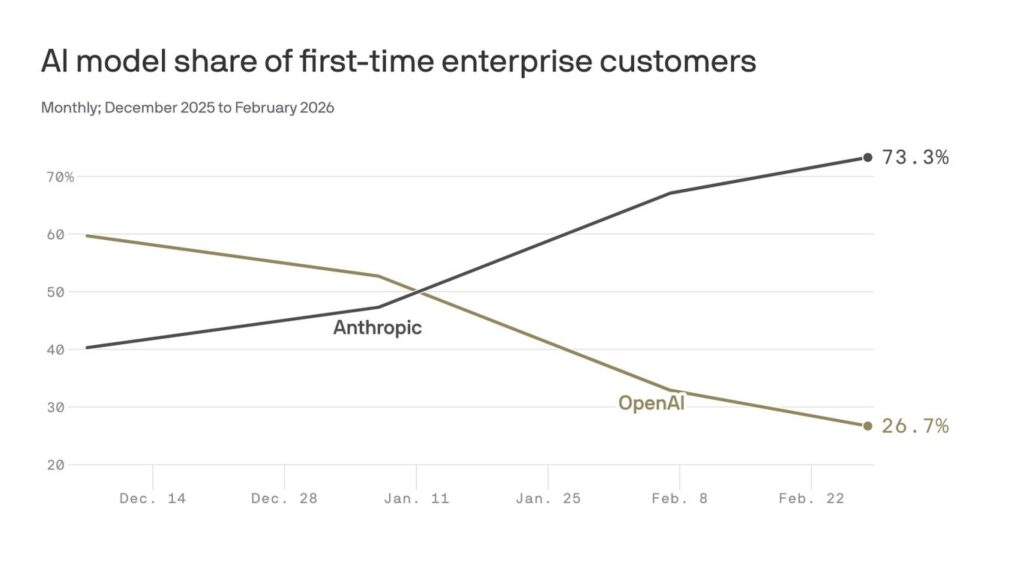
The AI landscape is evolving rapidly, with significant shifts in market dynamics just in the past few weeks. The recent split in market share between OpenAI and its competitors, notably Anthropic, paints a striking picture of an industry at an inflection point. Ten weeks ago, OpenAI enjoyed an even split in market influence, but internal data suggests this has since narrowed to a precarious 60/40 advantage in favor of OpenAI as of early December. This fluctuating competitive landscape not only showcases the agility of the major players but also underscores the pressing need for small-to-medium business (SMB) leaders and automation specialists to remain vigilant.
OpenAI, while recognized as the most popular chatbot for consumers, is currently absorbing losses by subsidizing consumer token usage. Such financial dynamics merit attention in evaluating the value proposition of any AI tool. Companies leveraging these platforms must weigh operational costs against potential ROI, particularly in an environment rife with competition. The anticipated revenue generation for OpenAI stands at $25 billion this year, compared to Anthropic’s projected $19 billion. However, the rapid acceleration of Anthropic indicates that OpenAI may not maintain its dominance for long.
This competitive scenario demonstrates the necessity of analyzing the underlying strengths and weaknesses of AI platforms available in the market. For instance, while OpenAI offers robust models and is at the forefront of consumer engagement, its financial model prompts questions around sustainability in the long term. Conversely, Anthropic has shown promise in scaling while potentially avoiding high consumer subsidies. The decision to choose either platform hinges on specific business needs; for instance, firms prioritizing innovation and a wider range of consumer applications may lean towards OpenAI, noting its extensive suite of capabilities across diverse mediums such as video generation and browsing. Conversely, businesses focusing on enterprise solutions may find Anthropic’s targeted approach better aligned with their goals.
Data integration tools also merit scrutiny, particularly platforms like Make and Zapier. Both tools allow for automation of workflows but differ notably in functionality. Make offers more advanced options for complex workflows, which can potentially yield higher ROI for organizations that require intricate task automation. However, it also comes with a steeper learning curve, making it less accessible for less technical users. On the other hand, Zapier provides a more user-friendly interface that caters to non-developers while being perfectly scalable for everyday automated tasks. This accessibility often translates into a quicker ROI, though businesses must evaluate whether the limitations on complexity will affect their longer-term automation capabilities.
As SMB leaders navigate these nuanced decisions in choosing AI and automation tools, data-driven insights become indispensable. For instance, businesses maintaining a forward-thinking mindset regarding AI advancements are advised to tailor their technology stack to both current and evolving needs. As echoed by multiple Fortune 500 executives, a reluctance to commit to a single platform arises from the rapid pace of technology evolution, which serves as a prudent reminder for SMBs to adopt a flexible approach towards adopting AI solutions.
The competition among AI firms signifies a broader trend toward “building the plane while it’s flying,” as articulated by Circle’s CEO Jeremy Allaire. The continual release of innovations, including those from the newly inaugurated open-source agent framework called OpenClaw, indicates a profound transformation in the technological landscape. These changes can potentially redefine how automation and AI tools are built to serve both consumers and enterprise organizations.
In summary, the choice of AI and automation platforms must involve a careful analysis of costs, capabilities, and scalability. The financial implications, operational efficiencies, and integration complexities should inform each decision made in this rapidly shifting environment. Companies that pay heed to the nuances of these technologies while keeping a watchful eye on competitive dynamics will be better poised to navigate the challenges and opportunities that lie ahead.
FlowMind AI Insight: In an era typified by rapid technological advances, SMBs must remain agile and adaptable, opting for platforms that not only meet immediate operational needs but also support long-term scalability and growth. A careful balance between comprehensive functionality and cost-effective solutions will become increasingly important as the AI revolution continues to unfold.
Original article: Read here
2026-03-18 07:00:00