
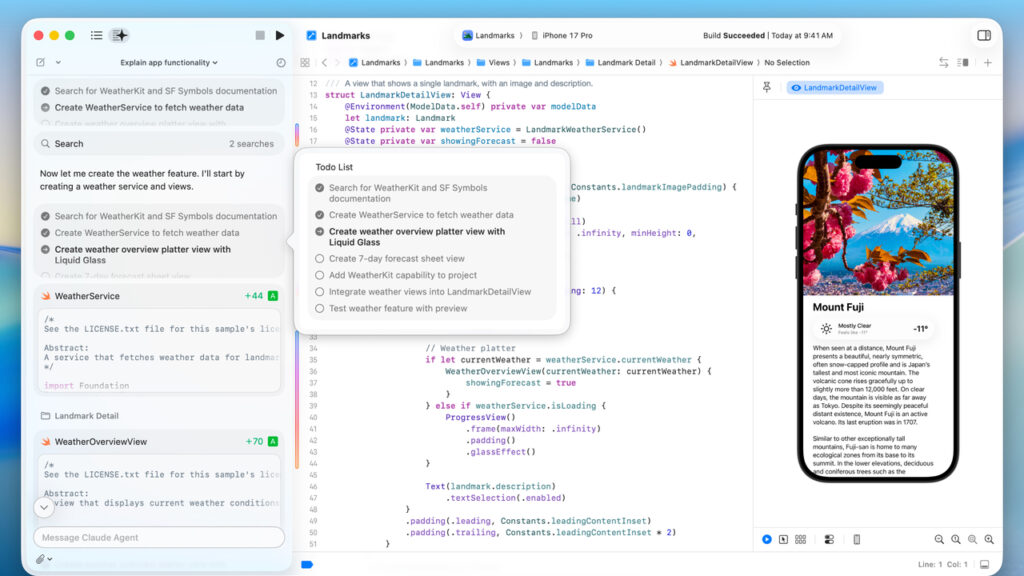
Apple’s recent introduction of Xcode 26.3, which incorporates autonomous AI agents into the coding environment, signifies a paradigm shift in software development workflows. The integration of “agentic coding” allows developers to leverage AI tools such as Anthropic’s Claude Agent and OpenAI’s Codex to manage complex programming tasks directly within Xcode. This advancement ultimately raises critical considerations for SMB leaders and automation specialists evaluating the competitive landscape of AI-driven solutions in software development.
The strength of this new tool lies in its ability to facilitate a more autonomous coding process. Unlike traditional code completion tools that merely suggest code snippets at the cursor point, the AI agents in Xcode 26.3 are designed to function with greater independence. They can deconstruct broad development goals into actionable tasks while considering the architectural context of the project. This shift not only speeds up the coding process but also reduces the cognitive load on developers, allowing them to focus on higher-level strategic elements of software creation.
In comparison, platforms like OpenAI’s Codex and Anthropic’s Claude Agent, which can also be utilized independently, present their own strengths and weaknesses. OpenAI’s Codex, especially with the recent launch of its standalone app for macOS, serves as a robust command center for orchestrating coding tasks across different environments. Its advanced reasoning capabilities allow for flexible integrations and prompt coding assistance. However, while Codex’s capabilities are expansive, they often require more tuning and customization to fit particular use cases, which can lead to increased startup costs and a longer ramp-up time for teams.
On the other hand, Anthropic’s Claude focuses more on ethical AI and understandable outputs, catering to organizations that prioritize transparency and safety in automation. This can present a competitive edge for businesses in highly regulated sectors, although the trade-offs may include reduced versatility in coding tasks compared to Codex. In terms of costs, both AI platforms typically fall within comparable subscription models, but the total cost of ownership can differ sharply based on the specific needs for customization, support, and concurrent usage across teams.
From a return on investment (ROI) perspective, the impact of integrating Xcode 26.3 cannot be overstated. By augmenting developer productivity and enhancing creativity through agentic coding, Apple positions the platform as a conducive environment for rapid application development. For SMB leaders, the potential return on investment becomes evident when considering the savings in time and resources. A recent study indicated that organizations employing AI-driven coding tools saw a productivity increase of up to 30%, translating into significant financial gains over time.
When we consider scalability, Xcode 26.3 shines with its Model Context Protocol, which allows developers to integrate any compatible agent or tool as needed. This flexibility effectively prevents vendor lock-in, permitting organizations to scale their tech stack in alignment with evolving business requirements. In contrast, tools like Make and Zapier predominantly service the low-code automation space, allowing users to create workflows across varying applications. While both tools have proven useful for SMBs, their effectiveness relies heavily on the skill levels of users and the specific operational contexts within which they function. Make offers more intricate workflow automation for advanced users, whereas Zapier is tailored for straightforward tasks that require less technical expertise.
As AI becomes further integrated into the core of development environments via platforms like Xcode 26.3, it is crucial for SMB leaders and automation specialists to remain cognizant of the landscape’s evolution. Organizations should invest in training staff to maximize the potential of these advanced tools while also prioritizing ethical considerations and transparency in AI deployments. Effective implementation will hinge on the alignment of AI tools with business objectives and team capabilities.
In conclusion, the advent of agentic coding via Xcode 26.3 underscores a new frontier in software development. With a closer look at the competitive offerings from OpenAI and Anthropic, combined with strategic implementation of Xcode’s newly integrated features, SMBs can derive substantial benefits. The future landscape will increasingly be defined by those agile enough to adopt these innovations and optimize their development processes effectively.
FlowMind AI Insight: The incorporation of autonomous AI agents into development workflows represents an inflection point for SMBs striving for greater efficiency and productivity. As firms assess their tools, a focus on training and ethical practices will facilitate meaningful adoption, ensuring that technology serves as an enabler rather than a hindrance in the pursuit of innovation.
Original article: Read here
2026-02-03 18:33:00