
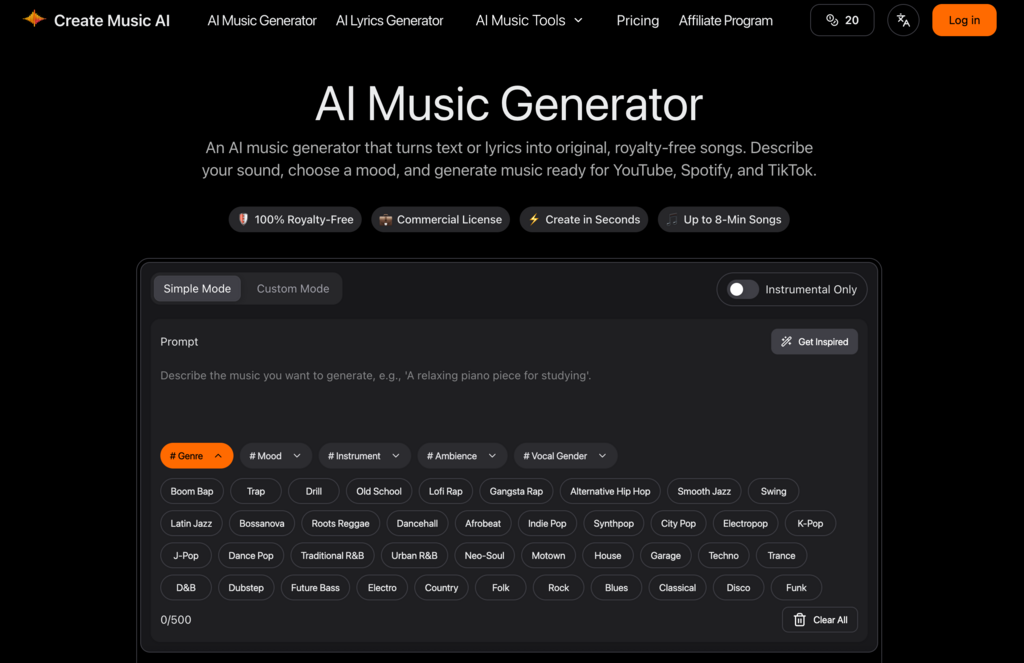
In the rapidly evolving landscape of the content economy, particularly as we approach 2026, the distinctions between amateur and professional tools have become increasingly blurred. This transition signifies a critical moment for creators, where the question is no longer whether to utilize artificial intelligence (AI), but rather which platforms offer the optimal blend of quality, legality, and functionality. In this context, Create Music AI emerges as a notable contender. This browser-based studio focuses on granular control and commercial viability, setting itself apart from more generic competitors.
The cornerstone of Create Music AI’s value proposition is its AI Music Generator. The platform distinguishes itself from the traditional “black box” generators that often deliver unpredictable outcomes by introducing a sophisticated dual-mode workflow. This is especially useful for serious producers who require precision and consistency in their musical outputs. The platform’s Simple Mode facilitates rapid ideation, allowing users to generate high-fidelity backing tracks using five-dimensional tags such as genre and mood. However, the real transformative potential lies within the Custom Mode. This feature enables users to input up to 5,000 characters of lyrics and define explicit structural elements like verses, choruses, and bridges. By aligning the generated audio with the storyteller’s narrative arc instead of a repetitive loop, Create Music AI effectively addresses significant pain points that have historically plagued AI-generated music.
In addition to its robust generative capabilities, the platform offers clarity on the legal frameworks surrounding its outputs. In an era defined by stringent copyright enforcement, Create Music AI provides 100% commercial rights for its generated tracks. This assurance is especially crucial for content creators such as YouTubers, game developers, and podcasters who depend on monetization that is legally secure. By mitigating risks associated with copyright infringement, Create Music AI positions itself as not just a tool, but a critical partner in the commercial success of its users.
While the generator itself is a standout feature, it’s crucial to consider the ecosystem that surrounds it. Integrated tools like vocal removers and stem splitters significantly enhance the utility of the platform, allowing creators to refine their raw output in real time. This means that users are not merely receiving a static WAV file; rather, they are engaging in a dynamic workspace where audio can be polished and prepared for final mixing. This integrated approach demonstrates a holistic understanding of creators’ needs, providing a one-stop solution.
To effectively analyze the competitive landscape of AI music generation tools, it is beneficial to compare Create Music AI with other prominent platforms. For instance, when juxtaposed with more established automation platforms such as Zapier and Make, we see distinct strengths and weaknesses. Zapier is celebrated for its extensive app integrations and user-friendly interface, making it appealing to small and medium-sized businesses (SMBs) looking for straightforward workflow automation. However, its rigid pricing model can discourage users who require heavier usage or advanced functionalities. Conversely, Make, also known for its flexible automation, tends to provide deeper customization at a slightly higher cost, catering more to advanced users.
In the AI landscape, platforms like OpenAI and Anthropic are also worth mentioning. OpenAI’s offerings, particularly in generative text and image models, have revolutionized numerous industries. However, their business models can be opaque, and inconsistencies in output quality may present challenges for business applications. On the other hand, Anthropic’s emphasis on safety and alignment makes it an intriguing option, particularly for sectors prioritizing data privacy. Nonetheless, its comparatively higher costs and limited model access may deter smaller enterprises from fully leveraging its potential.
When it comes to cost, the ROI on these tools can vary based on deployment strategies and specific use cases. For example, while platforms such as Create Music AI might command a premium price due to their commercial rights and advanced features, the return in terms of time saved and content quality can easily justify the initial investment. This aligns with a growing trend in business environments where long-term value often surpasses short-term expenditures.
To further enhance scalability, businesses should consider the allocation of resources towards training staff on these platforms and investing in best practices for integration. Greater initial upfront costs may be offset by operational efficiencies that these advanced AI tools provide, particularly as the demand for high-quality content escalates.
In conclusion, as we navigate the complexities of the content economy, the selection of AI tools cannot be taken lightly. Platforms like Create Music AI are setting new standards, especially for creators who require not just creativity, but also legal and commercial soundness. For SMEs and automation specialists, the strategic implementation of these tools can translate into significant competitive advantages.
The takeaways here are clear: invest in platforms that not only offer immediate functional benefits but also assure long-term commercial viability. Conduct thorough due diligence on the legal ramifications and ROI. Ensure that the selected tools seamlessly integrate with existing workflows to maximize overall impact.
FlowMind AI Insight: As the boundaries of creativity and technology continue to grow indistinct, prioritizing tools that elevate both artistic expression and legal assurance will be paramount. A strategic approach to AI adoption can set organizations on a path to sustained innovation and competitiveness in an increasingly dynamic landscape.
Original article: Read here
2026-01-24 18:36:00