
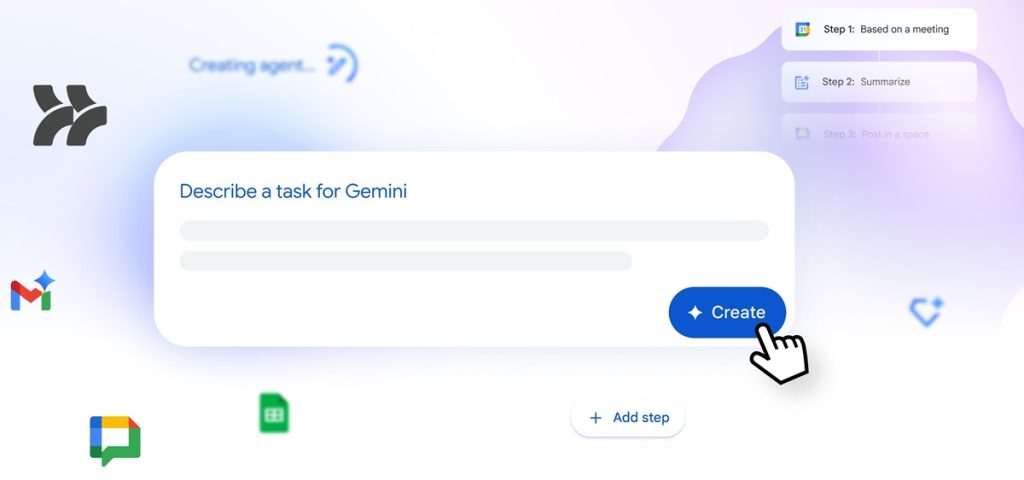
Google has recently unveiled the general availability of Google Workspace Studio, a platform specifically designed to allow users to create, manage, and share AI agents across its Workspace ecosystem. Leveraging the advanced capabilities of Gemini 3, Workspace Studio enables users to automate tasks without requiring extensive coding knowledge. This development marks a significant shift in the digital workspace, where automation has often been viewed as complex and reserved for technical personnel.
The primary objective of Workspace Studio is to alleviate the burden of routine digital tasks that consume valuable time and resources. Farhaz Karmali, Product Director for the Google Workspace Ecosystem, highlighted a crucial issue: traditional automation tools are often technical in nature and inflexible, making them difficult to adopt across various organizational levels. Workspace Studio seeks to democratize the automation process, enabling employees from different backgrounds to create agents that can understand context and efficiently execute tasks within familiar Workspace applications.
By employing Gemini’s reasoning and multimodal capabilities, Workspace agents can interpret context, adapt to new information, and support multi-step business processes. This positions them as more than just rule-based automation tools; they act as intelligent assistants capable of performing complex tasks such as sentiment analysis, content generation, and prioritization of assignments. With these capabilities, organizations can potentially transform their operational efficiency and focus on more strategic endeavors instead of spending time on mundane tasks.
An early adopter of this technology, Kärcher, partnered with Google Cloud affiliate Zoi to enhance their product feature evaluation. Their virtual team of agents efficiently handles various tasks, including idea assessment and technical feasibility checks. This innovation has led to a significant reduction in drafting time—by as much as 90%—allowing teams to transition from hours of review to approximately two minutes of streamlined productivity. Such efficiency gains illustrate the potential ROI of adopting Workspace Studio, particularly for time-strapped teams in fast-paced environments.
Workspace Studio is not exclusively beneficial for technical end-users. Its user-friendly design allows for agent creation to be accessible, even for those unfamiliar with coding. Companies can initiate projects using templates or describe automation requests in natural language, essentially bridging the technical gap that often hinders adoption. The early data from the Gemini Alpha program indicates that users are already leveraging these agents, completing over 20 million tasks within just one month. The ability to label incoming emails and extract data further underscores the platform’s versatility.
Integration is another critical component of Workspace Studio. Since the agents operate within existing tools such as Gmail, Drive, and Chat, they function with a greater awareness of organizational context, capable of utilizing content across various applications. This interconnectedness streamlines workflows and enhances productivity, aligning with the needs of today’s remote and distributed teams. Moreover, the platform’s capability to interface with external systems like Asana, Jira, and Salesforce expands its utility and potential for cross-platform collaboration.
When evaluating Workspace Studio against other automation platforms, such as Zapier and Make, several factors emerge that highlight its competitive advantages and disadvantages. Both Zapier and Make offer powerful automation capabilities, often praised for their user-friendly interfaces and extensive library of integrations. However, they tend to be more focused on simple workflow automations, limiting their ability to execute complex processes that involve contextual understanding.
In contrast, Workspace Studio, enriched by Gemini’s AI capabilities, offers a deeper level of automation that can adapt to new information and support nuanced business processes. This positions it as a more scalable solution for organizations looking to enhance their automation beyond rote task completion. However, as with any emerging technology, early adopters should remain aware of potential shortcomings in the form of integration delays or initial adoption friction, typically seen in comprehensive systems.
Cost is another vital consideration. While Google Workspace Studio will soon be available to business customers, determining its long-term value requires careful analysis. By systematizing routine tasks and enabling nuanced decision-making capabilities, organizations can achieve substantial return on investment, particularly as labor costs continue to rise. Leaders should conduct a cost-benefit analysis that evaluates not only upfront costs but also ongoing maintenance and operational efficiencies gained through reduced manual labor and improved productivity.
In summary, Google Workspace Studio represents a meaningful stride toward empowering organizations to harness the potential of AI and automation across their operations. It offers a compelling alternative to existing platforms by providing a combination of user accessibility, deep integration, and advanced capabilities that extend beyond simple task automation. As SMB leaders and automation specialists evaluate their options, it will be critical to consider both the immediate and long-term implications of integrating this technology into their workflow. By weighing factors such as scalability, context-aware automation, and service integration, organizations can make informed decisions about their digital transformation journey.
FlowMind AI Insight: As AI and automation tools evolve, organizations that leverage platforms like Google Workspace Studio can unlock immense value by streamlining processes and improving productivity. The focus should not solely be on short-term gains, but also on the long-term potential to adapt and scale automation capabilities in an increasingly data-driven world.
Original article: Read here
2025-12-04 04:12:00