
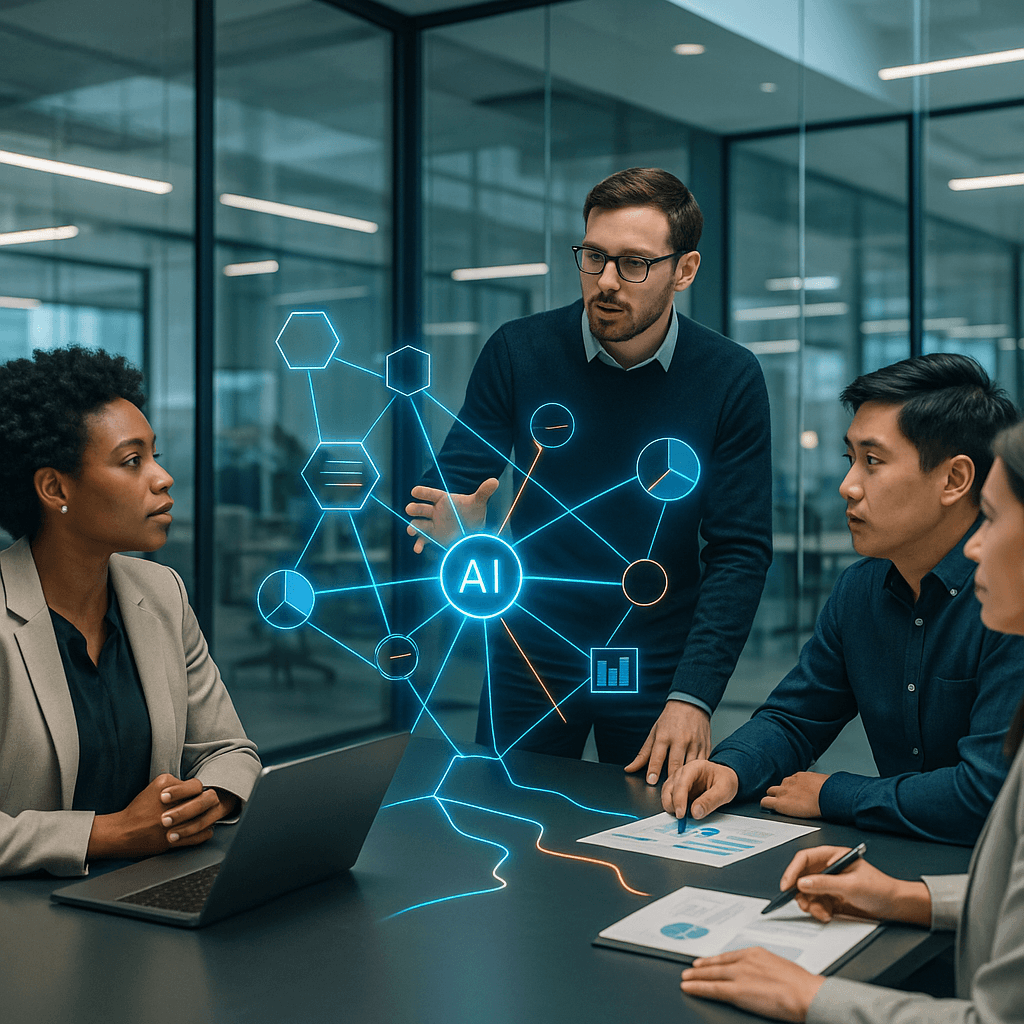
As artificial intelligence continues to evolve, the needs of organizations are shifting from simple question-answering and document summarization to more complex tasks requiring multi-user collaboration and social intelligence. A notable example of this emerging trend is a startup named Humans&, which recently secured a remarkable $480 million in seed funding—a figure that highlights investor confidence in its ground-breaking vision. The founding team boasts impressive credentials from industry leaders such as Anthropic, Meta, OpenAI, xAI, and Google DeepMind. Their ambition centers on moving beyond conventional AI tools to create systems focused on coordination rather than mere conversation.
Current AI platforms, ranging from established brands like OpenAI and Anthropic to automation solutions such as Zapier and Make, have mainly been optimized for individual user interactions. OpenAI’s suite is highly adept at generating text and answering queries, while Anthropic has focused on enhancing ethical AI interactions; however, both are ultimately constrained by their design to handle single-user tasks. This limitation can create inefficiencies in environments where group dynamics are pivotal, such as project management, decision-making, and collaborative brainstorming sessions.
Humans& aims to address these challenges head-on. Its foundational premise suggests that the future of AI lies in its ability to facilitate collaboration among teams rather than just provide isolated solutions for individual users. By framing AI’s next phase as a transition from primarily serving individual tasks to acting as a central nervous system for organizations, Humans& brings to the fore the inadequacies present within existing tools.
The company’s vision transcends the typical capabilities of chatbots. For instance, their comparative effectiveness hinges on an ability to manage workflows across diverse team members while keeping track of intricate group decisions over time. This is indicative of a broader need for systems that can balance competing priorities among stakeholders and facilitate meaningful engagement. The mundane example of selecting a company logo powerfully illustrates this point, highlighting the inefficiencies in traditional group decision-making processes that often require multiple iterations and discussions to reach a consensus.
When considering the strengths and weaknesses of existing platforms in the context of this rapidly evolving landscape, several key factors emerge. Cost and scalability feature prominently in evaluations of automation tools. Platforms like Zapier and Make offer notable ease of integration, allowing SMB leaders to automate tasks seamlessly across applications. However, their efficacy can diminish when they attempt to coordinate complex, multi-user scenarios that require nuanced understanding and decision-making across individuals. While Zapier prides itself on its user-friendly interface and expansive library of integrations, it may not fully address the complexity inherent in collaborative tasks. Make, while powerful in its modular capabilities, may also struggle to provide the situational awareness required for effective group coordination.
Moreover, return on investment (ROI) remains a critical consideration for SMB leaders. While AI tools like OpenAI provide powerful capabilities for generating insights and consumer-centric content, their focus on single-user experiences can potentially limit their long-term ROI in environments where team collaboration is essential. Conversely, tools designed to facilitate group coordination may yield higher ROI by enabling faster decision-making and improved efficiency, ultimately leading to more resilient and adaptable organizations.
The scalability of solutions also plays a vital role in their effectiveness. OpenAI and Anthropic have proven their scalability in numerous applications, but their singular focus might hinder firms looking for holistic solutions that incorporate social and collaborative dynamics. Humans&, with its orientation toward social intelligence, could address these gaps, providing a scalable framework that adapts to various team configurations and decision-making scenarios, thereby enhancing overall business resilience.
Investment in a platform designed explicitly for group collaboration could prove transformational for organizations navigating an increasingly complex business landscape. As SMB leaders weigh their options, aligning their operational needs with a tool’s capabilities has never been more crucial. Organizations should prioritize systems that empower teams rather than just assist individuals; this paradigm shift will facilitate higher levels of productivity and foster an engaged workforce.
In conclusion, the landscape of AI and automation is at a critical juncture, and organizations must embrace tools that facilitate coordination over simple interaction. The next generation of AI, as envisioned by innovators like Humans&, promises a more interconnected approach to problem-solving, one that leverages the collective intelligence of teams rather than the isolated capabilities of individual users. As you evaluate your options, consider the long-term implications of integrating a tool that not only scales with your business but enhances collaboration among your team.
FlowMind AI Insight: The evolution of AI presents a unique opportunity for SMB leaders to rethink their technology investments. By prioritizing solutions that enhance collaborative capabilities, organizations can gain a competitive edge in efficiency and adaptability, ultimately driving sustainable growth in a complex market environment.
Original article: Read here
2026-01-25 22:36:00