
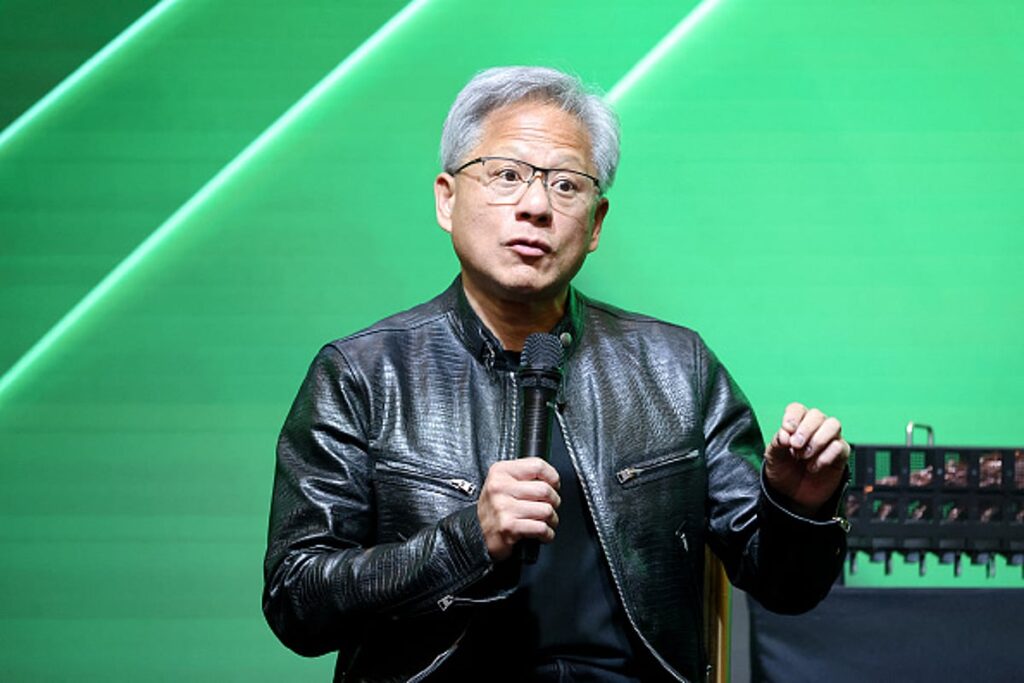
As the AI landscape continues to evolve, companies like Nvidia, OpenAI, and Anthropic are pivotal players shaping the future. Recently, Nvidia CEO Jensen Huang articulated the company’s approach to financial commitments with these companies amidst their prospective public offerings. His statements not only reveal Nvidia’s strategic position but also underscore the broader implications for businesses considering investments in AI and automation technologies.
Nvidia’s historical commitment to OpenAI, encapsulated in a previously announced $100 billion agreement, has been markedly curtailed. In his remarks at the Morgan Stanley Technology, Media, and Telecom conference, Huang elucidated that any further financial investments are “probably not in the cards,” especially as OpenAI prepares for a potential Initial Public Offering (IPO). Huang emphasized that transitioning to a public company diminishes the likelihood of continuing private investment. OpenAI’s anticipated IPO could value the company at a staggering $1 trillion, further highlighting the shifting financial dynamics in the AI sector.
The implications for smaller and mid-sized businesses (SMBs) interested in leveraging AI platforms are significant. OpenAI’s renowned ChatGPT has become a cornerstone in applications across customer service, content generation, and data analysis. However, SMBs must consider not just the initial outlay for AI tools, but also the long-term return on investment (ROI) these platforms can offer. As OpenAI and Anthropic move toward public listings, their pricing structures, scalability, and features will likely undergo scrutiny, influencing market dynamics and customer choices.
On the one hand, OpenAI is celebrated for its cutting-edge capabilities and user-friendly APIs, which reduce the technical barrier for SMBs deploying AI solutions. The wealth of training data that powers ChatGPT allows businesses to realize efficiencies that were previously unattainable. Yet, as the company prepares for a public offering, pricing models may evolve, potentially increasing costs and impacting ROI considerations for smaller firms.
Conversely, Anthropic positions itself as a competitor focusing on alignment research and responsible AI. While its emerging technologies are gaining traction for their ethical considerations, they may not yet rival OpenAI in breadth or user adoption. Anthropic’s potential may yield future value but currently presents a more speculative investment compared to OpenAI’s robust offerings.
When evaluating automation platforms, the decision between solutions like Make and Zapier becomes crucial for SMBs aiming to enhance operational efficiencies. Make has carved a niche with its visual workflow automation capabilities, allowing for complex integrations that can be pivotal for more technical users or those with intricate automation needs. In contrast, Zapier has established itself as a user-friendly choice, boasting a vast array of app integrations, making it ideal for non-technical users seeking quick solutions. This accessibility often translates to faster implementations, though some extensive workflows may be challenging to design within its framework.
The financial implications of selecting between these platforms should not be underestimated. While Make may demand a steeper learning curve and potentially more upfront investment in training, it can offer higher scalability and customization for businesses managing comprehensive workflows. In contrast, Zapier provides immediate utility but may incur recurring costs as businesses scale, especially when advanced features or higher usage tiers are necessary.
Both platforms provide distinct pathways toward operational optimization, and businesses must assess their specific requirements and capabilities. Understanding the nuances of each platform’s strengths and weaknesses helps leaders better position themselves in a rapidly evolving technological landscape.
As the dynamics of funding and public listings unfold among major AI players, SMBs must remain vigilant in monitoring pricing, feature updates, and market competition. The potential for new entrants and enhanced capabilities in the AI and automation space demands that leaders adopt a proactive stance in evaluating their technology investments.
FlowMind AI Insight: As AI and automation tools become increasingly integral to operational success, SMBs should consider not just current capabilities but also future scaling and integration potential. Continuous assessment of market trends and competitive offerings will be essential in driving effective technology investments that deliver sustained ROI.
Original article: Read here
2026-03-05 07:55:00