
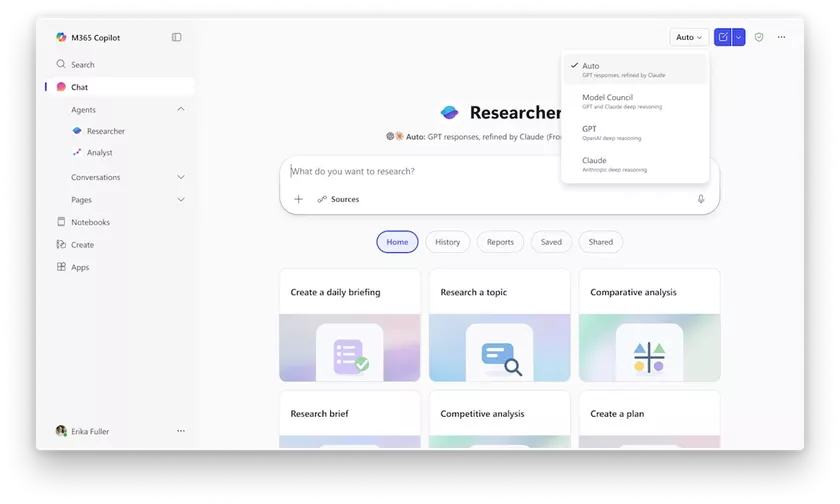
Microsoft’s recent enhancement of the Researcher tool within Microsoft 365 Copilot is noteworthy, particularly in its incorporation of multiple artificial intelligence models. This development not only raises competitive stakes among AI platforms but also invites deeper analysis into their strengths, weaknesses, costs, ROI, and scalability—factors essential for leaders of small and medium-sized businesses (SMBs) and automation specialists.
At the core of this new offering is the combination of OpenAI’s ChatGPT and Anthropic’s Claude, which exemplifies Microsoft’s commitment to leveraging a multi-model architecture for improved output. The Critique feature operates on sequential processing, where an initial response is generated by the GPT model and subsequently analyzed by Claude, resulting in a feedback loop that enhances factual accuracy, depth of analysis, and presentation quality. This approach imitates traditional research methodologies, which resonates with the expectations of business professionals who rely on evidence-based decisions.
Comparing this multi-model strategy with existing solutions such as Zapier and Make (formerly Integromat) unveils a critical insight. While Zapier offers ease of use and a wide array of integrations suitable for SMBs looking to automate workflows quickly, it falls short in terms of deep analysis capabilities. Make, on the other hand, provides more complex automation options but might overwhelm users without a strong technical background. In scenarios requiring thorough analysis or handling of intricate tasks, Microsoft’s Researcher tool could provide a competitive edge.
Moreover, the capability of the Researcher tool to provide nuanced insights surpasses deep search models from alternatives like Perplexity. SMBs often operate under constraints that necessitate not just fast solutions but accurate findings that can lead to informed strategic decisions. This capability is particularly useful when evaluating potential markets or understanding customer sentiments, making the Researcher tool a viable option for data-driven decision-making.
However, the deployment of such advanced AI capabilities does not come without considerations of cost. The entry into the Microsoft 365 ecosystem can be an investment. For existing Microsoft users, incremental costs might be manageable; however, newer users face the challenge of weighing the tool’s benefits against the total cost of ownership (TCO) in relation to their expected ROI. In an era where profit margins are razor-thin, the ability to project returns on investment based on data analysis becomes even more crucial for SMB leaders.
The introduction of the Model Council feature further expands the competitive landscape. By allowing users to obtain responses concurrently from both OpenAI and Anthropic models, stakeholders can readily identify divergences in perspectives. This feature not only serves as a validation tool but also exposes the inherent strengths and weaknesses of competing AI models. Such transparency is invaluable for businesses that prioritize accuracy and compliance.
Yet, while these advancements are impressive, they also underline the importance of scalability. SMBs often require solutions that can grow with their business needs. Microsoft 365, integrated with Azure, allows for scalability; however, businesses with specific needs may find that the broad applications of tools like Make or Zapier offer more tailored solutions for rapid deployment and adjustments, albeit at the risk of sacrificing depth.
The question that remains for business leaders is not just whether to adopt a new tool but how to integrate it into their existing workflows effectively. A well-structured training program for staff and an iterative implementation process can mitigate the risks associated with transitioning to advanced AI-driven tools. Businesses should prioritize understanding both the potential and the limitations of these platforms, ensuring that expectations align with capabilities.
In conclusion, Microsoft’s multi-model Researcher tool significantly enhances the landscape of AI applications for SMBs seeking to engage in deep analysis and informed decision-making. While the investment may seem substantial, the potential for high ROI through improved business intelligence justifies the expenditure. Business leaders should carefully evaluate the nuances of each tool, considering both immediate needs and long-term scalability.
FlowMind AI Insight: As AI technologies evolve, the ability to integrate multiple models into a cohesive tool will become a hallmark of advanced operational capability. Leaders should actively engage in continuous learning about these tools to make informed decisions that align with their strategic goals.
Original article: Read here
2026-03-30 23:39:00