
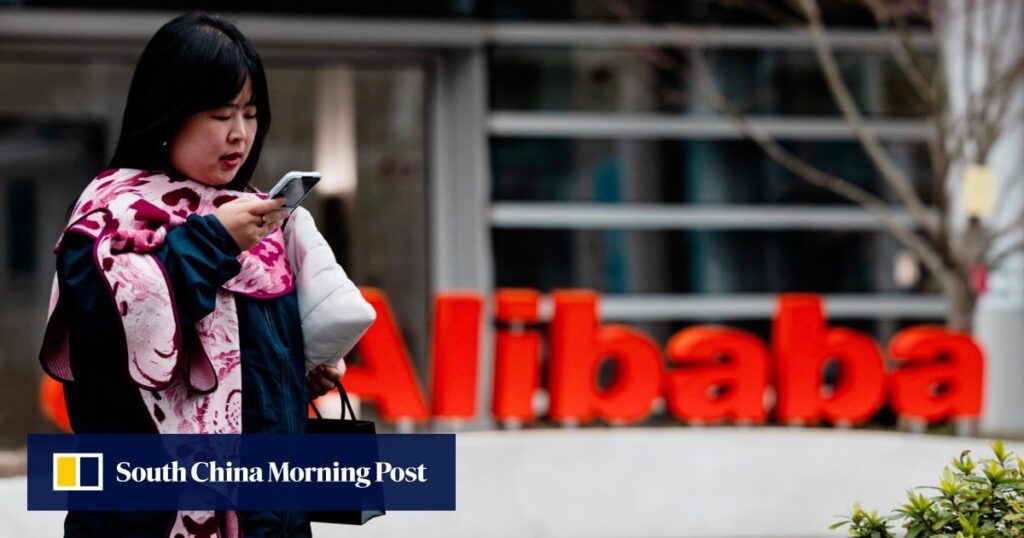
Alibaba Group Holding has recently made significant strides in the artificial intelligence landscape with its unveiling of the preview version of its most advanced AI model to date, Qwen3.5-Max-Preview. This development not only cements Alibaba’s position as a frontrunner in China’s AI race but also signals its intent to challenge established American giants such as Anthropic, Google, and OpenAI. By launching this flagship model, Alibaba is strategically navigating a competitive environment where AI capabilities are rapidly evolving and becoming integral to numerous business processes.
The Qwen3.5-Max-Preview model is currently available on Arena, a platform that measures model performance and has gained visibility for its rigor and user engagement thanks to contributions from researchers at UC Berkeley. With Qwen3.5-Max-Preview already ranking as the top Chinese AI model on the Arena platform and sitting at 15th globally, there is a clear indication of how Alibaba is working to bolster its technological competencies. This secure placement, although still trailing behind leading models from Anthropic and Google, emphasizes Alibaba’s progress and the potential growth that lies ahead if optimization efforts yield favorable outcomes.
One of the standout features of the Qwen3.5-Max-Preview is its impressive mathematical capabilities. Ranked fifth globally in this specific capability, it surpasses notable models from Anthropic and OpenAI, illustrating its strong analytical prowess which is increasingly essential in sectors requiring data-driven decision-making. The lag behind Anthropic and Google’s models highlights a nuanced landscape where strength in certain functionalities is crucial. The ability to perform complex calculations can lead to transformative applications in finance, logistics, and operational efficiency for businesses, revealing opportunities for Return on Investment (ROI) that shouldn’t be overlooked.
As the competition in AI delivery heats up, it’s vital for leaders in small and medium-sized businesses (SMBs) to weigh their options carefully. Key players like OpenAI and Anthropic not only provide powerful models but also offer varying degrees of support, scalability, and cost structures. OpenAI, with its robust suite of products including GPT models, provides extensive API access and is geared towards a variety of integrations, but this flexibility often comes at a price — both financial and operational. The initial investment in quality AI and the ongoing costs of scaling usage can add up, especially for smaller enterprises aiming for efficiency without sacrificing performance.
Conversely, Anthropic has focused on safety and interpretability, tailoring its models to ensure that AI outputs remain aligned with user intentions. This focus on responsible AI might not directly translate to cost savings at the outset, but in sectors where compliance and ethics are paramount, the long-term benefits could outweigh initial expenditures. The question for SMBs then becomes, what is the balance point between cost, flexibility, and ethical considerations?
Comparing Alibaba’s offerings with those from Western competitors also reveals opportunities for enterprises looking towards scalability. The Qwen 3.5 series illustrates innovations that can cope with substantial data loads, boasting features like one of the industry’s largest context windows at 1 million tokens. This scalability indicates that as businesses grow and accumulate data, the efficacy of their AI solutions will be crucial. Smaller organizations need to consider their projected growth when investing in AI solutions; choosing a model that can expand with their business will yield better ROI over time.
Furthermore, the economic landscape of AI is rapidly evolving. As companies integrate AI tools into their operations, analyzing the total cost of ownership (TCO) becomes essential. This includes not just upfront costs but also training, integration, maintenance, and potential productivity boosts. For instance, while platforms like Make and Zapier provide automation services, they differ significantly in ease of use, integration capabilities, and performance impact. Robust analysis of how these tools interact with existing systems—considering elements like user training and external support—will inform the decision-making process for SMB leaders.
The insights offered by platforms like Arena may serve as valuable guides, presenting a new dimension to performance evaluation in AI models. As more data becomes available, being able to leverage such performance benchmarks can help companies stay ahead of the curve, making informed decisions regarding AI adoption.
In conclusion, as Alibaba, OpenAI, and Anthropic vie for supremacy in AI advancements, SMB leaders and automation specialists will face critical choices. By prioritizing the analysis of strengths, weaknesses, costs, and scalability within AI platforms, businesses can forge paths that maximize ROI and foster growth. The sophisticated capabilities showcased by Qwen3.5-Max-Preview illustrate that while the landscape is competitive, the right blend of technology and strategy can yield substantial benefits.
FlowMind AI Insight: As AI technologies evolve, businesses must be agile in their approach to integrating these solutions. Utilizing performance benchmarks and understanding the nuances of tool capabilities will empower SMB leaders to make strategic decisions that enhance their operational efficiency and growth potential.
Original article: Read here
2026-03-20 07:00:00