
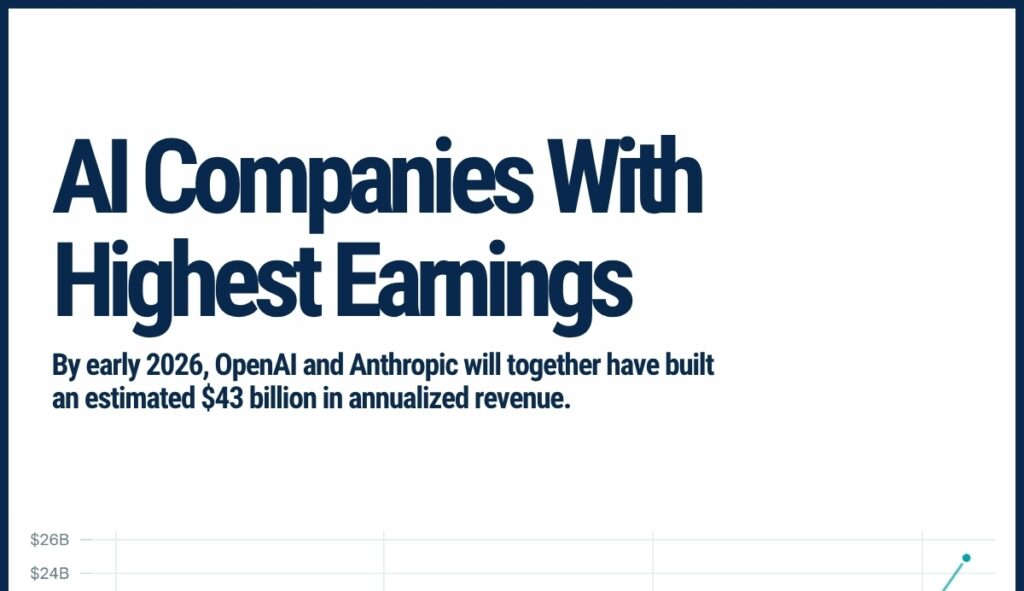
The landscape of artificial intelligence has seen remarkable changes and exponential growth over recent years, particularly evidenced by the revenue trajectories of leading firms in the sector. Recent data from Epoch AI outlines significant figures indicating that OpenAI’s annualized revenue is ringing in at around $24 billion by early 2026, while its closest competitor, Anthropic, follows with a substantial estimated revenue of $19 billion. Combined, these two giants are poised to dominate the commercial AI space, accounting for a staggering $43 billion in annualized revenue. In stark contrast, other companies within the Epoch AI database are grappling with modest revenue numbers that fade into insignificance on any standard graphical representation. This divergence presents a clear delineation within the industry, warranting a closer examination of AI and automation tool comparisons, especially between titans like OpenAI and Anthropic.
From a competitive standpoint, understanding the strengths and weaknesses of these platforms is critical for small and medium-sized business (SMB) leaders and automation specialists. OpenAI excels primarily in generative tasks, including language processing and content generation, leveraging its extensive model training to deliver results that often exceed user expectations. Additionally, OpenAI’s integrations are extensive, allowing businesses to incorporate AI capabilities seamlessly into their existing workflows. On the other hand, Anthropic’s focus on safety and ease of use separates it from OpenAI. While it might not yet have the same level of deployment or earnings, its emphasis on user-friendly interfaces and privacy concerns resonates deeply within sectors where data security is paramount. The choice between these two, therefore, hinges on a business’s strategic priorities: rapid generative capabilities versus a considered, secure approach to AI usage.
In terms of costs, OpenAI and Anthropic present distinct pricing structures that can influence ROI analyses. OpenAI’s API, while flexible, can become costly at scale, particularly for businesses engaging in high-volume transactions or extensive data processing. In contrast, Anthropic’s solutions may incur lower initial costs which can appeal to SMBs aiming for tighter budgets while still seeking to leverage AI technology. However, the return on investment in either case must account for the specific use cases and overall performance of the models—not merely the sticker price. This is where a data-driven approach becomes critical in quantifying the benefits against the costs.
When assessing scalability—a non-negotiable criteria for SMBs—both platforms have made strides, although with differing implications. OpenAI’s capabilities can scale quite rapidly, allowing businesses to adapt as their user base and data processing needs grow. This flexibility is attractive for firms poised for growth. However, it requires infrastructure that can support such scaling effectively. On the other side, Anthropic’s focus on a user-friendly experience suggests a less convoluted scaling process, as its tools aim to simplify integration and use, appealing particularly to teams with less technical expertise. Here, businesses should carefully consider their internal capabilities versus the offerings of each platform.
As organizations explore deploying these technologies, several actionable insights arise. For businesses concentrating on innovative content generation or needing robust natural language processing, OpenAI would likely yield higher benefits, although at a greater financial commitment. Companies looking to prioritize data privacy and user safety, particularly in regulated industries, should give Anthropic serious consideration for its design philosophy that emphasizes these aspects. Furthermore, weighing tools like Make and Zapier for automation can add layers of analysis; Make offers more comprehensive integrations and customizable workflows, which may suit more complex operational needs compared to Zapier’s streamlined, user-friendly interface that excels for basic automation tasks.
Ultimately, the choice of AI and automation tools should align with specific business objectives, anticipated scale, and resource allocation. An informed decision will not only enhance operational efficiency but also set a foundation for sustainable growth. As the industry dynamics evolve, continuous re-evaluation of these platforms will become vital, as new competitors emerge and existing players adapt.
FlowMind AI Insight: Continuing to track revenue trends and technological advances within the AI landscape will allow businesses to make informed, strategic choices that align with their long-term goals. Companies need to bridge the gap between innovating processes and managing costs while ensuring that their selected automation solutions are scalable and future-proof.
Original article: Read here
2026-03-27 16:55:00