
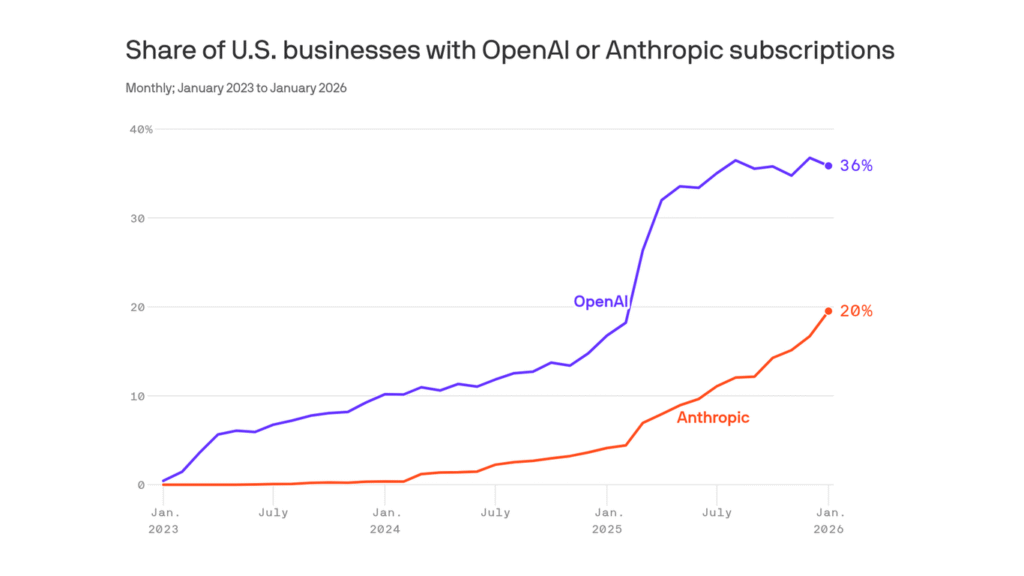
The evolving landscape of artificial intelligence (AI) platforms presents compelling opportunities for small and medium-sized businesses (SMBs) to enhance operational efficiency and decision-making. Recent data indicates a notable shift in the competitive dynamic between leading AI providers, Anthropic and OpenAI. According to Ramp, a financial technology firm serving approximately 50,000 companies, the proportion of companies investing in Anthropic has risen from 17% to 20%, while OpenAI’s share has experienced a slight decline from 37% to 36%. This emerging trend poses crucial considerations for SMB leaders and automation specialists tasked with evaluating potential AI investments.
Both Anthropic and OpenAI offer sophisticated AI-driven tools designed to facilitate a wide range of applications, from customer engagement to automation of internal processes. Notably, Anthropic has recently introduced a software coding product that gained significant traction, driving increased adoption rates. The implications of this adoption suggest that both platforms are not strictly competitive, as evidenced by the reported statistic that approximately 79% of OpenAI users also utilize Anthropic’s offerings. This symbiotic relationship indicates that businesses are not confined to a single AI vendor, but rather seek to leverage the unique strengths of multiple platforms.
From an analytical perspective, understanding the key strengths of these platforms is essential for SMBs deliberating on AI investments. OpenAI has established itself as a leader in consumer adoption, driven primarily by its well-known ChatGPT model. With a substantial user base and robust API capabilities, OpenAI presents a reliable option for companies looking to incorporate conversational AI into their customer service and sales processes. Furthermore, its ongoing iterative improvements and comprehensive training data can translate into a significant competitive advantage for businesses that prioritize customer engagement.
In contrast, Anthropic positions itself as a formidable alternative by emphasizing ethical AI development and user-friendly interfaces. Its latest coding product is an exemplar of intuitive design that enables businesses with limited technical expertise to harness AI capabilities. This focus on usability can lead to swift deployment across various functions, ultimately reducing time-to-value for companies. However, a consideration for SMBs is that Anthropic’s growth is concentrated in tech-savvy firms, as indicated by Ramp’s data, which suggests that those using Ramp are likely early adopters of advanced technologies.
When it comes to costs, both platforms present differing pricing models that companies should assess based on their budgets and projected ROI. OpenAI’s per-usage pricing may prove advantageous for companies anticipating variable usage, while Anthropic’s steady subscription model can offer predictable budgeting for ongoing expenses. Future investments should consider not only initial costs but also long-term implications of scalability. For instance, while OpenAI may command a more prominent market position at present, scalability may become a distinguishing factor as each platform evolves. Companies should evaluate the long-term adaptability of AI solutions, especially considering rapid technological advancements in the AI landscape.
Moreover, the upcoming December 2025 report from Menlo Ventures indicates that Anthropic has gained a substantial increase in enterprise LLM spending, capturing 40% compared to OpenAI’s 27%. However, it’s crucial to contextualize these figures. The Menlo report focused solely on API usage, which means it may not fully reflect consumer engagement through chatbot services, an arena where OpenAI continues to excel.
The swift adoption rate of AI solutions within businesses is noteworthy. As of January, nearly 47% of companies reported investing in AI, a marked increase from just below 7% the previous year. This rapid growth underscores the urgency for SMB leaders to integrate automation into their operations, capitalizing on efficiency gains and enhanced data analytics that AI offers.
In evaluating both platforms, distinct opportunities arise. Anthropic’s emergence presents a viable option for businesses keen on ethical AI and user-friendly tools, while OpenAI continues to dominate consumer applications and real-time engagement scenarios. However, choosing the right platform should hinge on an organization’s specific needs, resource allocation, and long-term strategic goals.
To summarize, the AI race between Anthropic and OpenAI is not a zero-sum game; SMBs can pragmatically benefit from leveraging both technologies where appropriate. As companies navigate the complexities of AI adoption, they should prioritize a clear understanding of platform strengths, pricing models, and scalability strategies. The right investment can enhance ROI and streamline operations, enabling businesses to remain competitive in an evolving market landscape.
FlowMind AI Insight: As seen in the shifting allegiances in AI adoption, organizations should not limit their perspectives to binary choices but embrace a multi-faceted approach to technology. The integration of superior tools, whether through Anthropic or OpenAI, can amplify business capabilities and sustainability when selected in alignment with strategic objectives.
Original article: Read here
2026-02-11 08:00:00