
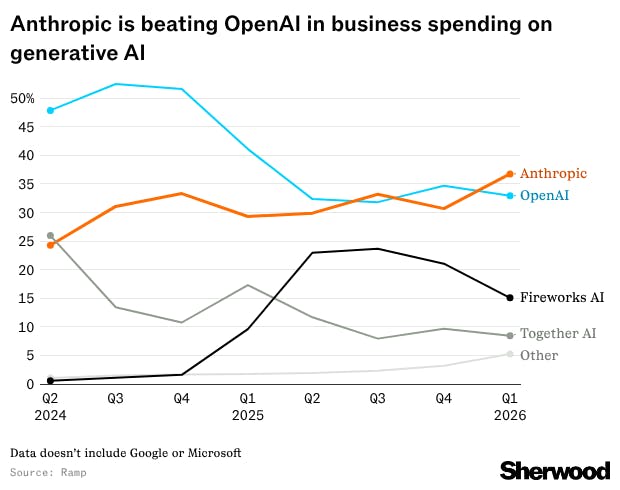
In the rapidly evolving landscape of generative AI software, competition among key players has intensified, with Anthropic recently emerging as a formidable contender against OpenAI. Recent data from Ramp reveals that Anthropic captured 37% of trackable business spending on generative AI in the first quarter, a notable leap compared to OpenAI’s 33% share. Despite OpenAI’s advantage in overall adoption, with 81% of AI buyers utilizing its tools, Anthropic is quickly closing the gap, reflecting a clear shift in the market dynamics when resource allocation is examined through a financial lens.
One significant factor contributing to Anthropic’s growing market share is its suite of enterprise tools—Claude Code and Cowork—targeted specifically at non-technical users and designed for smaller contract agreements. These attributes allow companies, particularly small to medium-sized businesses (SMBs), to adopt AI technologies without an overwhelming need for specialized expertise. Anthropic’s approach has resulted in its revenue skyrocketing, especially among first-time AI adopters, where its share has increased from 50% to 73%. This highlights a key strength of Anthropic’s offerings: the ability to democratize access to advanced AI capabilities for organizations that may lack technical resources.
On the other hand, OpenAI remains a powerhouse in terms of both adoption and brand recognition, largely due to its flagship product, ChatGPT. OpenAI’s stronghold of 81% among AI buyers indicates its established presence; however, the implications of a burgeoning competitor like Anthropic cannot be ignored. For SMB leaders, the decision to choose between these tools can often hinge on several critical factors: scalability, ROI, and cost-effectiveness.
Cost remains a pivotal consideration. OpenAI’s marketplace provides a tiered pricing structure that can accommodate various budgets while delivering advanced features. Yet, for organizations that prioritize affordability alongside functionality, Anthropic’s more accessible pricing model can serve as a compelling alternative. Moreover, the ROI can be calculated differently based on the specific operational needs of the company. Businesses focusing on basic automation tasks may find Anthropic’s offerings to be more intuitive and suitable for quick deployment, while those looking for robust, intricate systems may lean toward OpenAI.
As the data indicates, over half of Ramp’s customers currently invest in AI tools, marking an increase from just 18% two years prior. This clear trend underscores the growing acknowledgment among SMBs of the necessity to adopt automation and AI for enhanced operational efficiency and competitive advantage. However, the increasing choice of vendors poses unique dilemmas related to tool comparisons.
When analyzing the strengths and weaknesses of Anthropic and OpenAI one must consider the perspectives of those who are implementing these tools. Anthropic’s relative flexibility and targeted focus on less technical users serve as turbochargers for its adoption rates, while OpenAI’s broader capabilities and familiarity provide a reliable backbone for organizations investing in AI. Additionally, market dynamics suggest a shift toward diversified investments in AI as corporations recognize the need to balance different functionalities based on department requirements. For example, marketing teams may prefer OpenAI’s sophisticated NLP capabilities, while project management teams might value the simplicity and ease of integration offered by Anthropic.
Scalability also plays a crucial role in these comparisons. OpenAI, with its premier resources, can facilitate high scalability for large enterprises; however, Anthropic’s products are geared to scale within smaller firms effectively, which can be a substantial selling point for SMBs anticipating rapid growth or those experimenting with AI integrations on a smaller scale.
In the face of evolving competitive landscapes, SMB leaders must weigh the user-friendliness and targeted capabilities of Anthropic’s products against the broad and well-established capabilities of OpenAI. Balanced strategies that incorporate both platforms could yield optimal outcomes for varying business needs. Moreover, companies should not overlook potential repercussions tied to the sudden shifts in government relations, as seen with Anthropic’s fallout with the U.S. government, which may influence corporate decision-making based on perceived reliability and trustworthiness of the technological supplier.
Data-driven decision-making should guide the selection of AI tools, as both current and prospective users assess their functional needs, budgetary requirements, and situational risk tolerances. Leveraging insights from current market leaders and emerging challengers can empower firms to better navigate technological investments effectively.
Overall, the ongoing competition between OpenAI and Anthropic serves as a microcosm of the larger transformation occurring across the AI landscape—where innovation, user-centric design, and adaptability become paramount.
FlowMind AI Insight: As the generative AI market continues to evolve, the key for SMBs lies in understanding their unique operational needs and leveraging the strengths of platforms like Anthropic and OpenAI. By approaching AI tool adoption with a data-driven mindset, organizations can position themselves strategically for long-term success and growth.
Original article: Read here
2026-04-16 17:20:00