
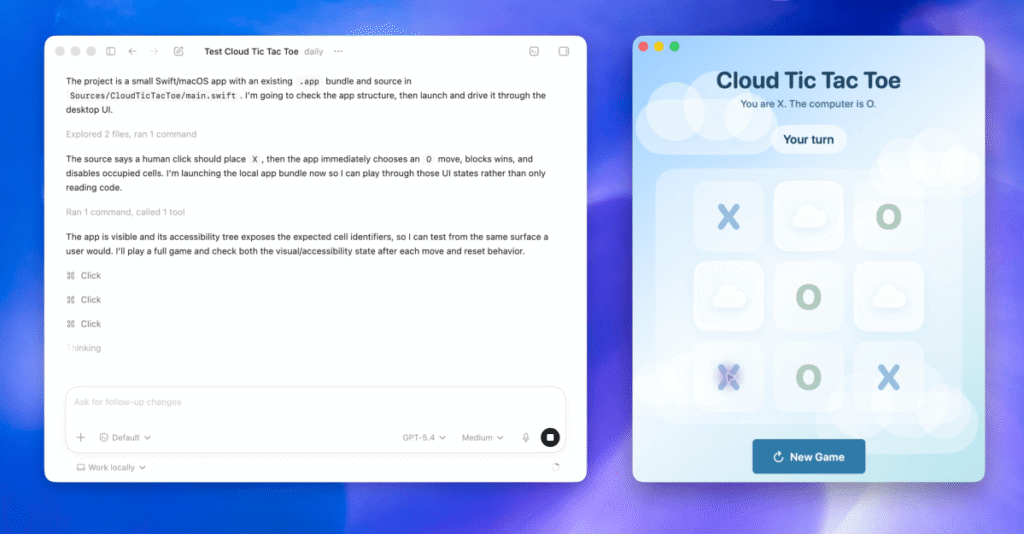
Recent developments in artificial intelligence and automation tools around OpenAI’s Codex present significant implications for small and medium-sized business (SMB) leaders and automation specialists. OpenAI’s latest announcement highlights several new features that augment the capabilities of Codex, making it a formidable contender in the crowded landscape of AI automation platforms. As AI continues to evolve, businesses must evaluate the strengths, weaknesses, costs, and potential return on investment (ROI) associated with various tools to make informed decisions.
The recent capability for Codex to operate desktop applications directly on a user’s computer without interrupting other tasks is a strategic advancement. This feature enables multiple agents to work in parallel, a boon for developers who can now test and iterate frontend changes and applications that lack API access. In contrast, established automation platforms like Zapier and Make rely heavily on pre-configured workflows that interface with applications through APIs. While these platforms simplify the automation of repetitive tasks, they can struggle in scenarios where a more direct interaction with software is necessary. Codex’s desktop capability could lead to more versatile automation scenarios, inherently increasing its value proposition.
However, the current rollout is limited to macOS users, leaving many potential users in the European Union and those on other operating systems in waiting mode. This limitation may hinder its immediate adoption among SMBs, necessitating a careful consideration of the available alternatives. Tools like Zapier and Make boast broad compatibility with various systems and applications, making them more accessible to a wider range of businesses. As the competitive landscape grows, the ability of AI tools to offer comprehensive support across various platforms will be crucial for long-term success.
Beyond operating desktop applications, Codex is expanding its functionality with the introduction of gpt-image-1.5, an enhanced capability for generating and iterating images. This feature, along with new plugins for platforms like GitLab, Atlassian Rovo, and Microsoft Suite, broadens the range of tasks Codex can perform. In comparison, platforms like Microsoft Power Automate have established integrations with the Microsoft Suite that enable seamless task workflows, reinforcing their longstanding relationship with SMBs that rely on Microsoft products. Though Codex is innovating with its enhanced functions, SMBs may prefer the reliability of existing solutions with proven track records of integration.
An essential development within Codex is its ability to automate tasks and schedule future actions autonomously, a feature that addresses the increasing demand for efficiency and time management within organizations. The capability to reuse existing conversation threads and set reminders for long-term tasks signifies a leap toward more intelligent task management. In contrast, other platforms might emphasize user-driven actions and notifications, potentially falling short in terms of proactive automation features. Businesses should consider the operational efficiency these intelligent capabilities could impart, allowing their teams to focus on core activities rather than administrative duties.
Moreover, Codex’s introduction of a memory feature presents an intriguing approach to personalization. By allowing Codex to remember historical interactions and user preferences, OpenAI aims to streamline future tasks, decreasing the time required to complete them. This is particularly relevant to SMBs that often face resource constraints. The idea of tailored interactions could differentiate Codex significantly from competitors like Anthropic, whose focus remains more on conversational AI without the same degree of contextual memory. Nevertheless, the opt-in nature of this feature raises questions about data privacy and user comfort, issues that SMBs must weigh carefully when considering the integration of AI automation tools.
In terms of cost considerations, OpenAI has not publicly disclosed pricing structures for Codex beyond initial use cases, leaving potential users uncertain about the financial commitment required. In contrast, platforms like Zapier and Make operate on tiered subscription models that can be adapted based on organizational needs. Therefore, while Codex boasts potential, businesses should cautiously approach decisions involving investment in yet-to-be-evaluated tools—especially when competitor offerings provide clear pricing and scalability options.
Taking all these factors into account, SMB leaders should consider a holistic view of their industry’s requirements when adopting automation tools. They must weigh the advantages of emerging features and capabilities against the memory, operating system limitations, pricing transparency, and personalization strategies provided by established platforms. Each tool’s ROI should be analyzed not just from a cost perspective, but also in terms of time saved, productivity gained, and the ultimate effect on business efficiency.
FlowMind AI Insight: As AI automation platforms evolve, organizations must remain agile in their tool selection, prioritizing functionality that meets specific operational needs. Doing so will enable businesses to maximize efficiency while ensuring the best alignment with their long-term strategic goals.
Original article: Read here
2026-04-16 17:00:00