
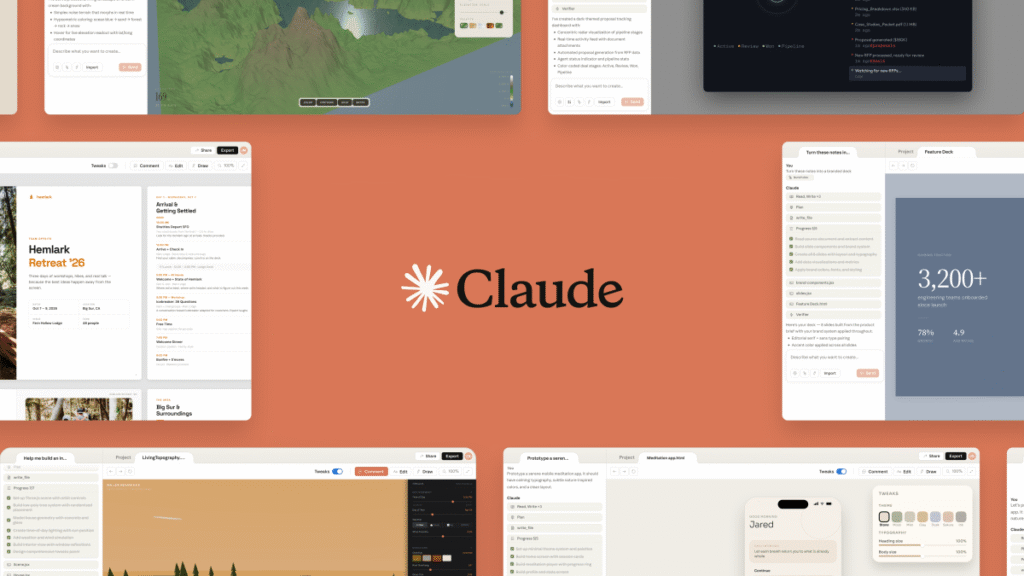
Anthropic’s recent announcement regarding the launch of Claude Design offers a new avenue for businesses to develop design materials quickly and intuitively. This tool is particularly aimed at founders, product managers, and professionals without a formal design background, facilitating a transition from conceptual ideas to tangible visuals. Compared to established design platforms like Canva, Claude Design positions itself as a complementary tool, enhancing, rather than replacing, existing solutions.
At its core, Claude Design leverages the advanced capabilities of Anthropic’s Claude model, enabling users to articulate design requirements in natural language. Users can request specific qualities of a design, such as “creating a serene mobile meditation app,” and obtain an initial prototype. This feature significantly reduces the barrier to entry for users lacking design expertise, allowing them to refine visuals through straightforward edits. While such accessibility is commendable, businesses need to consider the scalability and long-term viability of integrating this tool into their workflow.
When reviewing Claude Design against tools like Canva, several aspects emerge. Firstly, Canva functions as an all-in-one design solution, allowing both novice and experienced users to create and collaborate on a wide array of design projects. The platform’s extensive library of templates, images, and design elements combined with its collaborative features offer a robust environment for teams to efficiently produce marketing materials, presentations, and social media graphics. However, users still need a basic understanding of design principles to maximize Canva’s potential.
In contrast, Claude Design excels in initiating the design process. While working with Claude, users are not bound by preconceived templates or layouts, allowing for personalized designs right from the start. This presents a distinct advantage, particularly for businesses seeking to convey unique brand identities. However, the potential downside is that once users have produced these initial designs, they may still need to transition to more comprehensive tools like Canva for further customization and advanced features. This two-step process could introduce inefficiencies and complicate workflows if not managed properly.
Financially, the return on investment (ROI) for adopting a new tool like Claude Design will depend on the volume of use and the specific needs of the organization. For SMB leaders, initial costs should be weighed against potential productivity gains. Claude Design, currently available for Claude Pro, Max, Team, and Enterprise subscribers, could offer a favorable ROI if teams aspire to rapidly prototype ideas and iterate as necessary. Conversely, companies might find that the need to shift between platforms — from creating a design in Claude to further refining it in Canva — could incur additional costs and time that undermine efficiency.
The capacity to align designs with a company’s existing branding is another critical consideration for SMB leaders. Claude Design’s ability to integrate a team’s design system ensures consistency across generated visuals, enhancing brand integrity. This feature can be useful for companies managing multiple projects or maintaining a unified corporate identity. However, leveraging this capability requires an understanding of the design system involved, which could necessitate additional training or adaptation for team members unfamiliar with such frameworks.
Looking at the competitive landscape, the emergence of AI and automation tools has transformed how businesses approach design and collaborative work. For instance, OpenAI and Anthropic are both making strides in reducing friction across workflows. OpenAI’s tools have gained significant traction in generating text and code, while Anthropic’s offerings emphasize user-friendliness and alignment with design principles. This differentiation can affect the decision-making process for leaders considering which platform to adopt, as understanding each tool’s strengths and weaknesses will be critical for optimizing operations.
In a market that increasingly values agility and responsiveness, tools that streamline processes are essential for maintaining competitive advantage. Claude Design represents a noteworthy innovation that reflects a growing trend towards AI-assisted design. However, it is imperative for businesses to clearly define their needs, evaluate how well a tool aligns with those needs, and consider the longer-term implications of integrating one solution over another.
Investments in automation platforms should be strategic, balancing immediate functionality with future scalability. For SMB leaders, this means continuously assessing how tools can enhance not just one-off tasks but the overall operational ecosystem.
FlowMind AI Insight: As AI-driven tools proliferate, businesses must remain vigilant in evaluating their design and automation strategies. By leveraging platforms like Claude Design alongside established solutions such as Canva, organizations can optimize workflows, enhance productivity, and convey clear brand messaging, driving both efficiency and creativity.
Original article: Read here
2026-04-17 15:00:00