
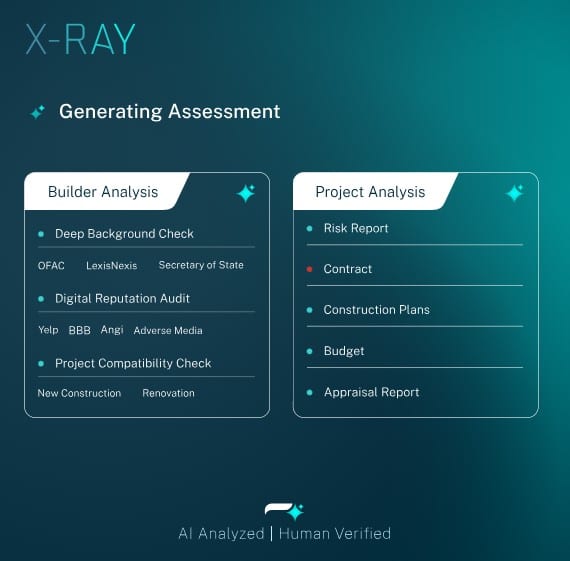
In the competitive landscape of construction loan management, innovations in artificial intelligence and automation are becoming pivotal for small to medium-sized businesses (SMBs). Land Gorilla has recently unveiled X-RAY, an AI-powered due diligence tool designed to enhance risk assessment in construction lending. This innovative approach can help lenders mitigate project, budget, and contractor concerns before closing loans, thereby streamlining processes and reducing operational costs.
When comparing X-RAY with other automation tools available in the market, we can look at platforms like Buildertrend and CoConstruct, both of which also cater to construction project management but focus on distinct areas. Buildertrend excels in overall project management but has limited functionalities specifically for financial risk assessment. CoConstruct offers robust client and contractor communication features, but its risk analysis capabilities do not match the depth provided by X-RAY.
X-RAY stands out due to its focused approach on lending risks associated with construction projects. It conducts data-driven assessments on project feasibility, budget accuracy, and contractor reliability. Unlike Buildertrend, which requires significant manual input for financial assessments, X-RAY automates the analysis through advanced machine learning algorithms. In real-world scenarios, lenders who have adopted X-RAY report faster loan closing times and a notable reduction in missed rate locks.
When evaluating pricing, Land Gorilla offers flexible plans for different company sizes, which can be a significant consideration for SMBs. In contrast, Buildertrend and CoConstruct present flat-rate subscription models that may not be tailored for businesses with varying project needs. Small lenders often benefit more from services like X-RAY, which align closely with their operational workflow, potentially leading to more effective use of financial resources.
In terms of integrations, X-RAY allows seamless incorporation with existing loan management systems. This feature is crucial for lenders who are already accustomed to certain platforms and wish to maintain continuity. Buildertrend and CoConstruct also offer integration but require more manual processes to connect with financial assessment tools, which can slow down overall efficiency, especially in urgent scenarios.
Support is another vital factor for SMBs when adopting new technologies. Land Gorilla provides dedicated customer support that emphasizes rapid response times and personalized service, which can significantly aid businesses in the initial stages of implementation. On the other hand, Buildertrend and CoConstruct deliver extensive resources online, including community forums and tutorials, but they may not offer the same level of personalized support, especially during critical project phases.
Migrating to X-RAY involves a few simple steps, starting with a low-risk pilot program. Lenders can select a small group of projects for initial use, allowing them to gauge the platform’s effectiveness without overcommitting resources. The transition should involve training sessions with key personnel to quickly acclimatize them to the software’s functionalities. It’s advisable to leverage initial pilot data to adjust the system optimally according to the lender’s operational needs prior to wider deployment.
A total cost of ownership analysis shows that while initial implementation costs for X-RAY may be higher than other generic tools, the return on investment becomes evident within three to six months. Enhanced project approval rates and quicker loan closure times increase revenue, thus offsetting initial expenses. The predictive capabilities of X-RAY enable lenders to make informed decisions earlier, reducing the chance of costly project overruns.
FlowMind AI Insight: The adoption of targeted AI solutions like X-RAY can be instrumental for SMBs in the construction lending space. By implementing a focused tool that addresses specific challenges related to lending risks, these businesses not only enhance their operational capabilities but also position themselves strategically for future growth in a highly competitive environment. This alignment with advanced technology is crucial for maintaining a competitive edge and ensuring long-term success.
Original article: Read here
2026-06-16 13:43:00