
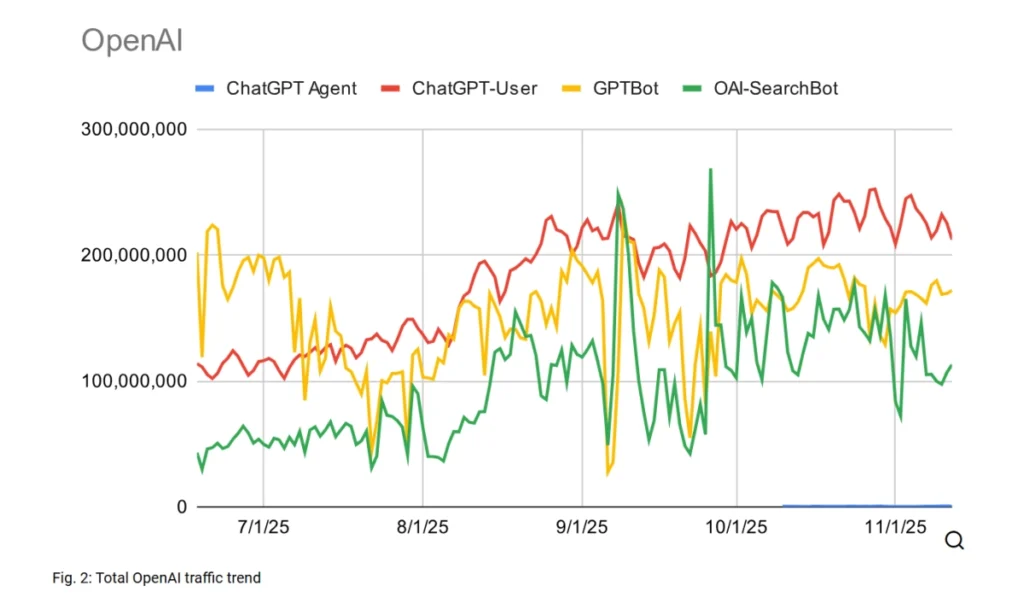
The digital landscape is rapidly evolving, particularly as artificial intelligence becomes a cornerstone of business automation. A recent report from Akamai revealed that OpenAI is the dominant force in AI bot traffic, accounting for 42.4% of all measured AI requests. This statistic is a strong indicator of not only OpenAI’s extensive operational capacity but also the increasing centralization of AI services around this single provider. Companies are now faced with the challenge of navigating this landscape, balancing efficiency and cost-effectiveness while also addressing potential operational headaches associated with high-frequency bot traffic.
OpenAI’s various strategies set it apart from other competitors like Anthropic and Perplexity. While other platforms are confined to niche roles—mostly revolving around training or search functions—OpenAI employs a portfolio of bots designed to serve diverse operational needs. The foundational GPTBot is used primarily for developing and training language models, the OAI-SearchBot focuses on indexing vast data pools, and the ChatGPT-Agent facilitates task execution. However, it is the real-time data retriever, the ChatGPT-User, that raises the most concerns for web publishers and e-commerce operators due to its tendency to hit sensitive API endpoints at high frequencies.
Unlike Anthropic, which predominantly utilizes its training crawler, OpenAI leverages multiple channels for generating traffic, resulting in a multi-faceted operational profile that cannot be ignored. This opens a dialogue about how businesses should evaluate the trade-offs between different AI platforms. In comparative analyses, platforms like Make and Zapier also come into consideration for automation tasks. Make is generally favored for its visual workflow design, allowing non-technical individuals to automate tasks easily, while Zapier offers a more extensive list of integrations, albeit sometimes at the cost of flexibility. Choosing the right platform needs careful evaluation to ensure alignment with organizational objectives, ease of use, and long-term viability.
As business leaders assess the costs and return on investment (ROI) associated with platforms like OpenAI, it becomes crucial to weigh not only the benefits but also the drawbacks. OpenAI’s comprehensive services come at a premium, making it essential to calculate whether the investment translates into scalable growth or merely inflates operational expenses without substantial gains. Additionally, organizations may find themselves increasingly investing in countermeasures against ChatGPT-User traffic, which can dilute ROI if mitigation actions require extensive resource allocation.
The expectation here is clear: companies must evolve from passive acceptance of AI traffic to a more proactive management approach. This transformation involves establishing clear strategies for engaging with AI bot traffic, particularly from dominant players like OpenAI. Some organizations may choose to permit access to the training crawler while imposing strict limits on user-driven requests, effectively balancing the benefits of data retriever capabilities with the operational challenges they present.
When evaluating the scalability of AI platforms, business leaders should also pay attention to integration capabilities with existing systems. OpenAI, while robust, demands a comprehensive strategy to manage its expansive functionalities effectively. In contrast, smaller or more specialized platforms might be more cost-effective but could lack the scalability required for growing demands. The ability to adapt and scale is particularly crucial for small and medium-sized businesses (SMBs) that must remain agile in a competitive landscape.
In conclusion, the decision-making matrix surrounding the adoption and integration of AI tools has become increasingly complex. Organizations must conduct thorough analyses not only of platform capabilities but also of how these impact overall operational efficiency and cost structures. By doing so, they can achieve a more sustainable operational model that prepares them for future challenges while maximizing the advantages presented by automation and AI technologies.
FlowMind AI Insight: Organizations must strategically navigate the evolving AI landscape, weighing the benefits against the operational complexities introduced by dominant players like OpenAI. A data-driven assessment of costs and scalability will be essential in ensuring that investments yield both operational efficiency and long-term growth.
Original article: Read here
2025-11-24 17:57:00