
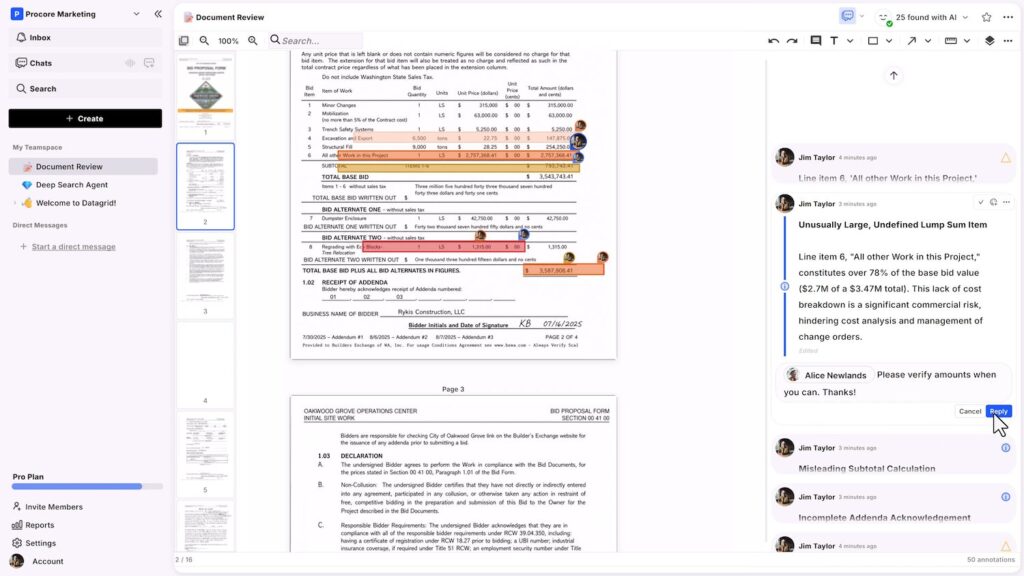
In recent years, artificial intelligence (AI) has made significant inroads in various industries, including construction. With the rise of digital platforms, companies are beginning to rely on AI tools to enhance project management, streamline communication, and refine decision-making processes. However, these tools can vary widely in terms of functionality, reliability, and integration capabilities. This article compares two AI tools tailored for small to medium-sized businesses (SMBs) in the construction sector: Procore and Autodesk BIM 360.
Procore stands out due to its robust integration of AI through its Datagrid feature. Unlike many existing AI tools that function as chatbots over fragmented datasets, Datagrid is embedded directly within Procore’s platform. This capability allows it to interpret ongoing project activities, determine necessary actions, and implement them without the need for third-party applications. Engineers and project managers can access insights and recommendations seamlessly, enhancing team collaboration and project efficiency.
Conversely, Autodesk BIM 360 emphasizes visualization and collaboration. Its AI features focus on offering predictive insights regarding project risks and schedule delays. This platform serves as a centralized hub for project stakeholders, enabling sharing of BIM models and facilitating effective communication. While BIM 360 excels in visual data representation, it often requires users to navigate between various tools to extract actionable insights, which can be a drawback for teams that prioritize streamlined workflows.
In terms of reliability, Procore’s Datagrid has been proven effective in real-world scenarios, such as executing large-scale projects like the San Francisco International Airport’s Terminal 1 renovation. By integrating findings from past projects and current tasks, teams were able to make data-driven decisions, reducing project delays. Autodesk BIM 360, while reliable, tends to require users to manually input data from various sources, which can introduce errors and inefficiencies.
When assessing pricing, Procore operates on a subscription model. Costs vary based on user tiers and the specific features chosen, making it a potentially scalable solution for SMBs. Autodesk BIM 360 offers similar pricing structures, but additional costs may arise from necessary third-party plugins or additional storage. For SMBs with tight budgets, Procore may offer a more straightforward value proposition since it integrates most AI features within its overall project management framework.
Integrations also play a crucial role in choosing the right AI tool. Procore boasts an extensive array of integrations with well-known applications in the construction industry, such as Microsoft Teams, Dropbox, and Google Drive. This connectivity enables users to centralize their workflows, reducing data silos. Autodesk BIM 360, while able to integrate with certain software, often requires additional setup to connect disparate tools effectively, leading to potential implementation challenges.
Each tool has its limitations. Procore may be less robust in advanced visual planning features compared to Autodesk BIM 360’s 3D modeling capabilities. On the other hand, BIM 360 can fall short in its real-time actionable insights compared to Datagrid, which acts on data to initiate tasks automatically.
Support is another critical aspect to consider. Procore offers 24/7 customer support, ensuring that users can resolve issues in a timely manner. Its user community and extensive documentation also provide helpful resources for troubleshooting and knowledge sharing. Autodesk BIM 360 provides decent support but can be slower in response times, which may hinder teams needing immediate assistance.
The choice between Procore and Autodesk BIM 360 often comes down to specific project needs. For teams seeking seamless integration with a focus on real-time insights and task automation, Procore is the superior choice. However, for those prioritizing advanced design visualization and collaboration across multiple disciplines, Autodesk BIM 360 can be more suitable.
For migration, transitioning to either tool requires a strategic approach. Both platforms offer onboarding assistance to help teams adapt. Testing can start with a small project that mirrors typical workloads to understand how the tool fits into existing workflows. Organizations should select a low-risk pilot project with predefined metrics for success. This approach mitigates the risks associated with full-scale implementation and allows for refinement before a wider rollout.
The total cost of ownership for these tools tends to go beyond initial subscription fees. Factors like user training, ongoing support, and potential integration costs must be considered. In general, SMBs can expect ROI within three to six months, as streamlined processes and reduced labor costs from automation can lead to significant time and resource savings.
FlowMind AI Insight: When choosing an AI tool for construction management, the decision should assess not only current project needs but also long-term operational efficiency. Tools like Procore and Autodesk BIM 360 each offer unique advantages, and understanding those will empower SMBs to make informed choices that enhance productivity and ultimately drive profitability.
Original article: Read here
2026-05-26 13:23:00